

Conditions · evidence guide
HBOT for ME/CFS: What the Evidence Shows
HBOT is not FDA-cleared for ME/CFS, and no placebo-controlled trial has ever been completed. The study most often cited as proof is a fibromyalgia trial. The strongest direct evidence is a 30-patient uncontrolled cohort, and the first sham-controlled ME/CFS trial is recruiting right now. Here is the full record, including what the marketing mixes up.
The short answer
Three verdicts, one page
Searches for HBOT and chronic fatigue syndrome blend three very different statements into one answer. Separating them is the whole story: how thin the direct evidence is, what ME/CFS actually is as a diagnosis, and which studies the market borrows from other conditions to fill the gap.
The honest thin bucket
No placebo-controlled trial of HBOT for ME/CFS has ever been completed. The direct human literature is four publications: one randomized pilot whose "control" group also received HBOT, one uncontrolled 16-patient series, one single-patient brain-scan report, and one uncontrolled 30-patient cohort with encouraging results. The first sham-controlled ME/CFS trial started recruiting in July 2026, with results expected around 2027-2028.
What ME/CFS actually is
A clinical diagnosis, not a mood and not ordinary tiredness: substantial impairment lasting more than six months, post-exertional malaise, and unrefreshing sleep, plus cognitive impairment or orthostatic intolerance (IOM/NAM 2015 criteria). Up to 3.3 million Americans may have it, and more than 9 in 10 are undiagnosed (CDC). The NICE guideline for ME/CFS never mentions hyperbaric oxygen at all.
The diagnosis mix-up machine
The study most often cited as proof HBOT helps "CFS" enrolled 60 women with fibromyalgia, a different diagnosis. The famous randomized trials are in long COVID, a different population, and they split: one positive, one null against sham. This page names every diagnosis on every citation, because which patients were studied is the whole question.
Two disclosures frame everything below, and they belong at the top. First, HBOT is not FDA-cleared or approved for ME/CFS: the cleared indications cover wounds, carbon monoxide poisoning, decompression sickness, and ten other conditions, and ME/CFS is not among them (FDA, archived; UHMS indications). The NICE guideline for ME/CFS goes further in its own way: the word "hyperbaric" appears nowhere in its recommendations at all (NICE NG206). Second, neither Medicare nor commercial insurers pay for it (NCD 20.29), which makes this a cash market aimed at people who have often spent years waiting for a diagnosis, let alone a treatment. Those people deserve the whole record, not the highlight reel. New to the therapy itself? Start with how hyperbaric oxygen therapy works.
If you are exhausted and do not yet have a diagnosis, this page is not your next step; a physician is. ME/CFS is a clinical diagnosis made after other causes are ruled out, and the mimics, anemia, thyroid disease, sleep apnea, depression, diabetes, heart disease, are common and treatable (IOM/NAM 2015; CDC). And the rule that shapes everything below: post-exertional malaise is a core criterion of this illness, which means exertion, including the exertion of a daily treatment schedule, can make patients worse. Any intervention sold to this community has to respect that, and any page about one has to say it.
Why oxygen became the pitch
The mechanism story, graded
ME/CFS research keeps pointing at problems HBOT plausibly touches: reduced oxygen use, neuroinflammation, brain hypoperfusion. Plausible is a real word with a real limit, and the distance between it and proven is this page.
The pitch runs like this: ME/CFS involves mitochondrial dysfunction, neuroinflammation, and impaired oxygen delivery; HBOT dissolves far more oxygen into blood plasma than normal breathing and influences inflammation and repair pathways; therefore sessions should relieve the fatigue. The first two clauses are legitimate science. The conclusion is where the record thins out. The only direct ME/CFS mechanism work published is preclinical: a 2026 mouse study found that hyperbaric oxygen improved fatigue-like behavior and memory in a stress-induced CFS model, tracking a neuroinflammatory pathway (Zhao 2026). On the human side, the Charite cohort produced the first imaging correlate: thalamic hyperconnectivity that shifted toward the healthy pattern after HBOT, most strongly in the patients who improved (Kim 2026). That is genuinely interesting. It is also a mouse model plus one uncontrolled cohort, and the history of fatigue medicine is littered with plausible mechanisms that died in controlled trials.
For what HBOT legitimately does to oxygen delivery and dose, our chamber pressure levels guide covers the honest version, and the brain fog research guide maps the broader cognitive literature. This page grades the ME/CFS-specific claims against the ME/CFS-specific literature, all four human publications of it, plus the trial that will finally test them.
The citations
The evidence, study by study
Every direct ME/CFS publication that exists, plus the registered trial that will finally settle it. Read the design column first: in this literature, the design is the finding.
| Study | Design & population | Protocol | What it found | Level |
|---|---|---|---|---|
| Van Hoof et al. 2003 J Chronic Fatigue Syndr | Randomized pilot, 29 CFS patients (CDC 1994 criteria), Belgium. Arm A: 15 patients PCR-positive for Mycoplasma. Arm B: 14 patients without the infection. CRITICAL DETAIL: BOTH arms received HBOT; there was no placebo or sham group | Multiplace chamber, 100% oxygen by mask, 2 hours per day for one week | The primary repeated-measures analysis found NO statistically significant differences on any measure. Scattered unadjusted trends favored the infected subgroup (general fatigue p=.03 at one week); bodily pain significantly WORSENED during treatment (p=.010) before returning toward baseline. The authors themselves urge caution. This is the strongest "trial" marketing pages cite, and it shows the question was never properly tested | Randomized pilot, no placebo arm |
| Akarsu et al. 2013 Undersea Hyperb Med | Uncontrolled pre-post series, 16 CFS patients (Fukuda criteria), Turkey; no control group of any kind | 15 HBOT sessions over 3 consecutive weeks | Fatigue scores (VAFS, FSS, FQLS) improved after the course (all p<0.005); treatment was well tolerated. The authors state plainly that larger controlled studies are awaited. A real signal in a design that cannot separate treatment from expectation, attention, and natural fluctuation | Uncontrolled series (n=16) |
| Mairal et al. 2021 Eur J Nucl Med Mol Imaging | Single-patient imaging report from the Marseille hyperbaric center: a CFS patient with widespread cortical hypometabolism on FDG-PET | HBOT course (clinical hard chamber) with brain PET before and after | The reported hypometabolism reversed after HBOT. One patient, no control: a mechanism hint, not evidence of benefit | Case report (n=1, imaging) |
| Kim et al. 2026 (Charite Berlin) J Transl Med | Prospective single-arm cohort, 30 ME/CFS patients (Canadian Consensus Criteria, post-exertional malaise required); 30 matched healthy controls used for MRI comparison only, NOT as a treatment control | 40 sessions, 100% oxygen by mask at 2.0 ATA, 90 minutes with air breaks | Physical functioning (SF-36 PF) improved versus baseline (g=0.71, p=0.006), fatigue and pain likewise; thalamic hyperconnectivity shifted toward the healthy pattern, most in responders. High adherence, no major adverse events, zero dropouts for PEM. The strongest direct ME/CFS dataset that exists, and the authors themselves say it is a rationale for controlled trials, not a verdict | Uncontrolled cohort (n=30) |
| Zhao et al. 2026 Neurochem Int | PRECLINICAL: a CFS-like mouse model (3-week multi-stressor paradigm); no humans involved | HBO 100% oxygen at 2.5 ATA, 60 minutes, 4 sessions per week for 3 weeks | Improved fatigue-like behaviors and memory in mice, with reduced hippocampal neuroinflammation (PLA2G4A/PGE2 pathway). Mechanism plausibility in an animal model; mice are not ME/CFS patients | Animal study (mechanism) |
| NCT07621068 (Sagol Center, Assaf Harofeh) ClinicalTrials.gov, recruiting | THE DECISIVE ROW: the first randomized, double-blind, SHAM-controlled trial of HBOT for ME/CFS ever registered; n=74 planned, triple-masked; recruiting since July 2026, estimated completion June 2027 | 60 sessions, 100% oxygen at 2.0 ATA versus a convincing sham (brief 1.2 ATA ramp for ear sensation, then 1.02 ATA) | No results yet. This is the design that can actually answer the question this page is about. Until it reads out, every positive uncontrolled claim sits under a question mark, and every certainty is marketing | Sham-controlled RCT (underway) |
PMIDs, DOIs, and links for every row are in the sources card. The synthesis: four direct human publications, none with a placebo or sham group; one mouse study for mechanism plausibility; and the first sham-controlled ME/CFS trial registered and recruiting as of October 2026. Thin is not the same as empty, and neither word changes what is proven, which today is nothing.
The one randomized pilot, read closely
The Van Hoof 2003 pilot is the study that taught us to read the methods before the abstract, because the word "randomized" hides the design. Twenty-nine CFS patients were randomized, yes, but both arms received hyperbaric oxygen; the comparison was between patients with and without a Mycoplasma infection, not between HBOT and placebo. The primary analysis found no statistically significant differences on any measure. A handful of unadjusted t-test trends favored the infected subgroup, and one measure, bodily pain, significantly worsened during the treatment week. The protocol itself was one week of daily two-hour sessions (Van Hoof 2003). The correct conclusion is not that HBOT was tested and failed. It is that in four decades of selling this protocol to this community, nobody has ever run the placebo-controlled test.
The positive 2026 cohort, read fairly
The Charite study is the best direct evidence this page has, and it deserves fair treatment in both directions. Thirty rigorously diagnosed ME/CFS patients completed 40 sessions at 2.0 ATA; physical functioning, fatigue, pain, exercise capacity, and processing speed all improved, and the brain-imaging changes moved in the same direction as the symptoms (Kim 2026). The caveats are structural, not rhetorical: no control group, which in a fatigue condition is close to disqualifying on its own. Here is why, in one number. In the rigorous long-COVID sham trial, the sham group improved just as much as the HBOT group, and the primary endpoint difference was p=0.87 (HOT-LoCO 2025). Patients who commit to a multi-week protocol, get daily attention, and expect to improve often do, whatever is in the mask. What the Charite study genuinely establishes is feasibility and safety: high adherence, no major adverse events, and zero dropouts for post-exertional malaise, which matters enormously for this population. What it cannot establish is efficacy. The authors say exactly that, and the trial that can say more is already recruiting.
The citations that are not about you
Three diagnoses, kept separate
The ME/CFS marketing pages borrow their best numbers from two neighboring conditions and one wellness category. Here is what each borrowed citation actually studied, because which patients were enrolled is the whole question.
Fibromyalgia is not ME/CFS
The single most-cited study on competitor ME/CFS pages is Efrati 2015: a real, properly registered trial, 40 sessions at 2.0 ATA, symptom improvement with brain-imaging changes. It enrolled 60 women with fibromyalgia (Efrati 2015). Fibromyalgia and ME/CFS overlap, share researchers, and often coexist in the same patient, but they are distinct diagnoses with distinct criteria, and a positive trial in one is a hypothesis generator for the other, not evidence. A page that cites this study for "CFS" without naming the diagnosis is asking you to fund a category error.
Long COVID is not ME/CFS
The strongest HBOT-and-fatigue trial in existence, Zilberman-Itskovich 2022, randomized 73 post-COVID patients against a sham and found real improvements in cognition, energy, sleep, and pain (Sci Rep 2022). Then the field did the harder experiment: HOT-LoCO randomized 80 long-COVID patients to 10 sessions or sham, and both groups improved equally (BMJ Open 2025). Both cohorts were post-COVID, not ME/CFS; the overlap is real, some long-COVID patients do meet ME/CFS criteria, but the populations differ, and the split result is the standing warning for every uncontrolled ME/CFS number on this page. Our long COVID research guide covers that adjacent evidence on its own terms.
Wellness fatigue is not ME/CFS
One more boundary, aimed inward this time. Our own energy and fatigue research guide is written for the wellness intent: healthy people chasing performance and recovery. ME/CFS is a disabling clinical diagnosis, and the distance between "afternoon crashes" and "crashes after exertion that last for days" is the distance between a wellness purchase and a medical question. If you are here because you are tired, that guide is the honest read. If you are here because you are sick, stay, and bring the criteria (IOM/NAM 2015) to a physician before you bring a credit card to anyone.
The symptom that changes the math
Post-exertional malaise: the PEM problem
Every condition page in this series has a safety section. This one has something more specific: the defining symptom of ME/CFS collides head-on with the way HBOT is sold.
Post-exertional malaise is a core diagnostic criterion of ME/CFS: physical or mental exertion triggers a delayed worsening of symptoms that can last days or weeks (IOM/NAM 2015). Now hold that against the standard commercial protocol: sessions five days a week, for six to twelve weeks, plus the commute, the waiting room, the changing, the schedule. The treatment delivery is itself an exertional load placed on the exact symptom that defines the illness. A provider who has never heard the phrase "post-exertional malaise" should not be selling packages to this community, and one who has heard it should be building pacing into the plan, not selling intensity.
The one published adherence dataset belongs here, because it is reassuring and bounded at once. In the Charite cohort, the schedule was adjusted for tolerability, adherence was high, no major adverse events occurred, and not one patient discontinued because of PEM or worsening ME/CFS symptoms (Kim 2026, full text). That is real feasibility evidence from a supervised research setting with screening, monitoring, and permission to adjust. It is not evidence that an unsupervised commercial package carries the same risk profile, and it is not a reason to push through crashes. The rules that follow from it: screening and pacing belong to a clinician who knows your baseline, stopping rules get agreed before session one, and a crash is a signal to stop and reassess, never a sign that "the treatment is working."
The decision math
Clinic package versus home chamber, in the open
Many people reading this page are not choosing whether to try HBOT at a clinic. They are choosing between a five-figure clinic package and buying a chamber for the house. Here is the math, and next to it, what is known versus what is unknown.
The clinic route
No studied, agreed ME/CFS protocol exists: the published human courses ranged from one treatment week (the 2003 pilot) and 15 sessions (the 2013 series) to 40 sessions (the 2026 cohort), and the registered sham trial uses 60. Clinics commonly sell packages in the 40-60 range, five days a week, a daily commute for two to three months. No clinic publishes ME/CFS-specific prices. For order of magnitude only: the 2026 plastic-surgery systematic review reports per-session prices of $150-650 in the HBOT literature (Molina-Vega 2026), and one clinic in the adjacent off-label brain-injury market has published $5,000-8,000 for a 40-session block. A long package lands in four-to-five-figure territory, cash, with no insurer behind any of it (NCD 20.29). How coverage works for the indications that are covered is mapped in our insurance coverage guide.
The home-chamber route
The home market is aimed squarely at this audience, because daily sessions at home sound manageable when leaving the house is hard, and that logic is not stupid; it is just unproven. Soft 1.3 ATA units sell for several thousand dollars and up; clinical-class hard chambers cost ten times that (our own lineup and pricing are on the home chamber page, and the full economics in the chamber cost guide and the home versus clinic comparison). Now the honesty the sellers skip. What is known: every published ME/CFS datum comes from 2.0-2.5 ATA clinical hard chambers with 100% oxygen; soft units cannot reach that class; no study of any design exists at 1.3 ATA for ME/CFS. What is unknown: whether any pressure, any protocol, any chamber helps at all, because the controlled test has never been completed. A home chamber converts an unproven per-session expense into an unproven capital expense. The unknown does not get smaller when you own the equipment, and with PEM in the picture, "convenient daily access" cuts in both directions.
The comparison that matters
Set both routes against the free one. A diagnostic workup costs a physician visit and is the only route that has ever produced a treatable answer for a fatigued patient, because the mimics are common and many are fixable (CDC). A chamber package is a bet that an untested intervention helps a condition no proven therapy exists for. You are allowed to make that bet with your own money; you deserve to make it knowing those are the terms, and knowing that the decisive trial is already running (NCT07621068). Waiting for a real answer is a legitimate strategy too. Our how many HBOT sessions guide shows what session counts look like in the indications that actually have evidence, for contrast.
The equipment side
Pressure classes, and nothing more
The ME/CFS community is heavily marketed mild home chambers, so the equipment question deserves a straight answer. Here is the dose class that appears in the literature, the hardware categories, and zero outcome claims, because no equipment class has ME/CFS outcome data to claim.
Every published human ME/CFS study used a clinical hard chamber at 2.0-2.5 ATA with 100% oxygen, and the sham-controlled trial now recruiting uses 2.0 ATA. Soft portable chambers operate around 1.3 ATA, typically concentrator-fed rather than 100% medical oxygen, and their FDA clearance covers acute mountain sickness only: they cannot reach the pressure class of even the thinnest published ME/CFS data, such as it is. Our own soft-shell S1 (1.3-1.5 ATA, concentrator-fed) sits in that class, and we do not present it as ME/CFS equipment, because nothing is. The regulatory and engineering details live in our medical-grade chambers explainer, the ATA pressure guide, and the soft-shell chamber guide.
For an operator whose clients keep asking about ME/CFS, the equipment-class takeaway is narrow and factual: clinical hyperbaric work, the kind every study on this page used, sits in hard-shell, medically engineered territory, with certified pressure vessels, documented oxygen delivery, and trained oversight. The single-person rung of that class in our lineup is the Superhuman L1 (2.0 ATA hard-shell, from $49,900), with the two- and four-person models shown below. Our chambers are built to that engineering class, which is the only claim we make here. It is a claim about hardware. It is not a claim about ME/CFS, and on this page it cannot be: no chamber, ours or anyone else's, has controlled outcome data for this illness.
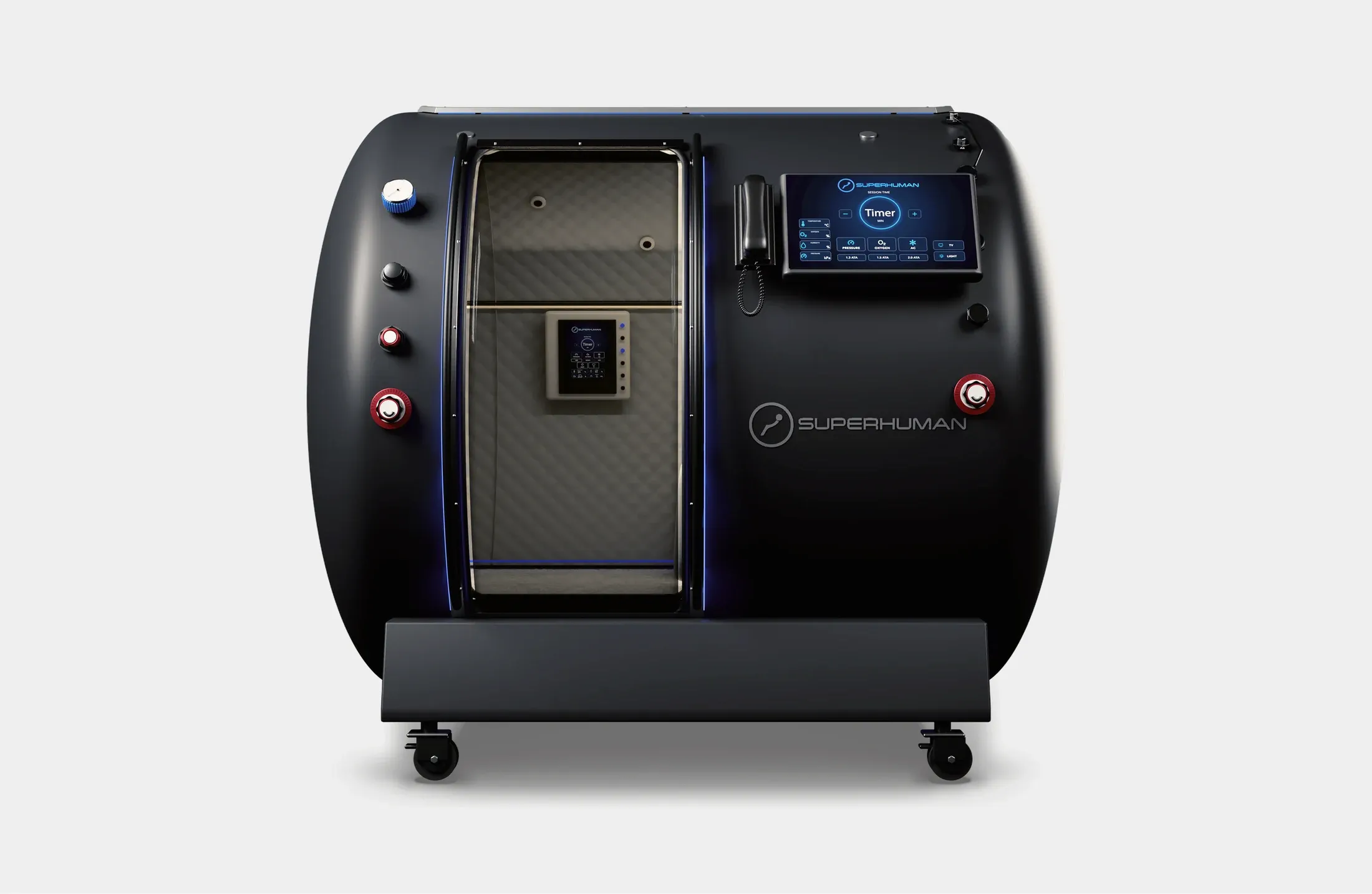
Superhuman T2: 2.0 ATA hard-shell, ASME and PVHO-1 tested, built in an ISO 13485 medical-device facility
Superhuman T2, from $99,900 →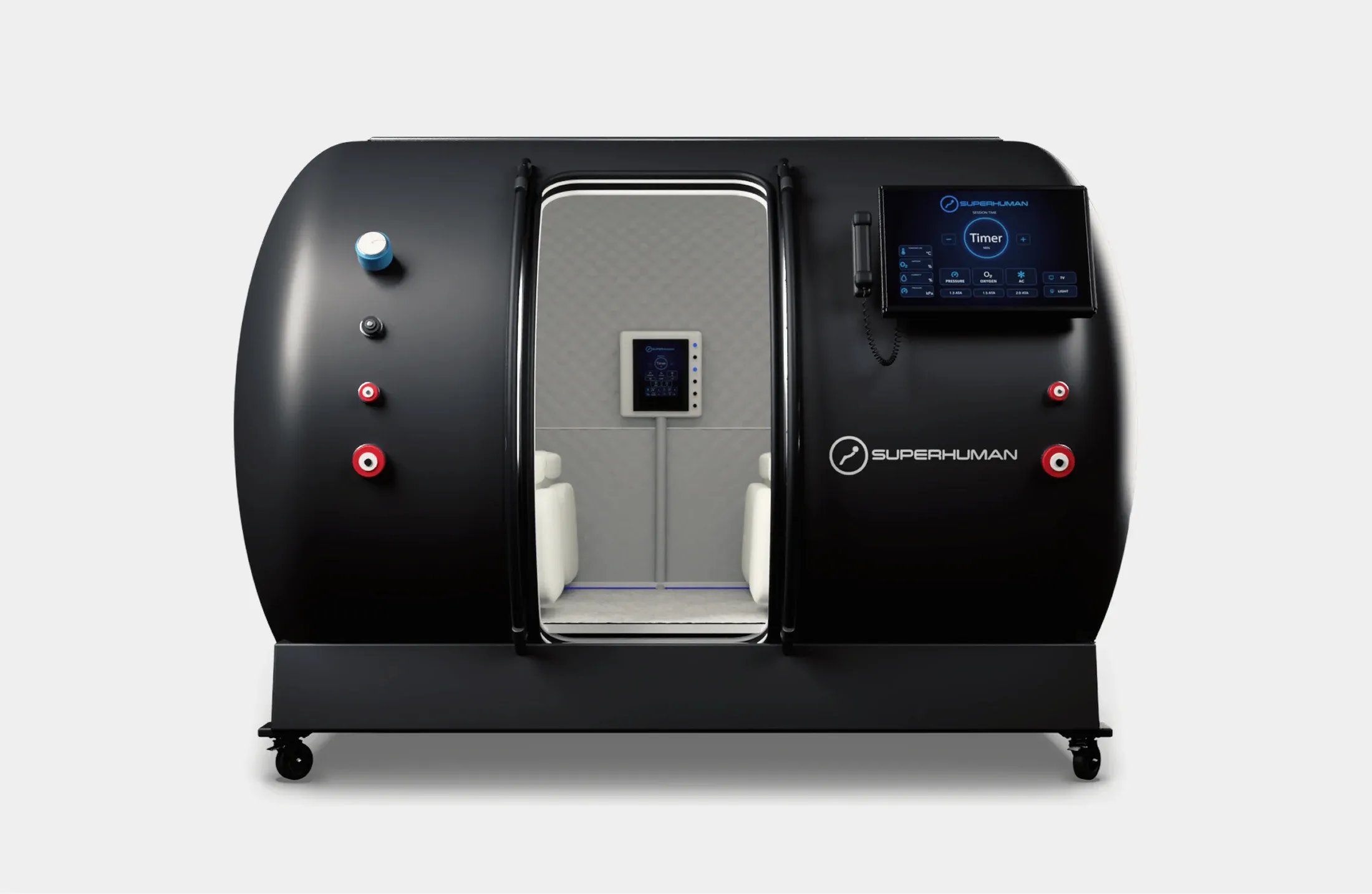
Superhuman T4: 2.0 ATA hard-shell for four occupants, ASME-certified vessel, clinical-scale throughput
Superhuman T4, from $169,000 →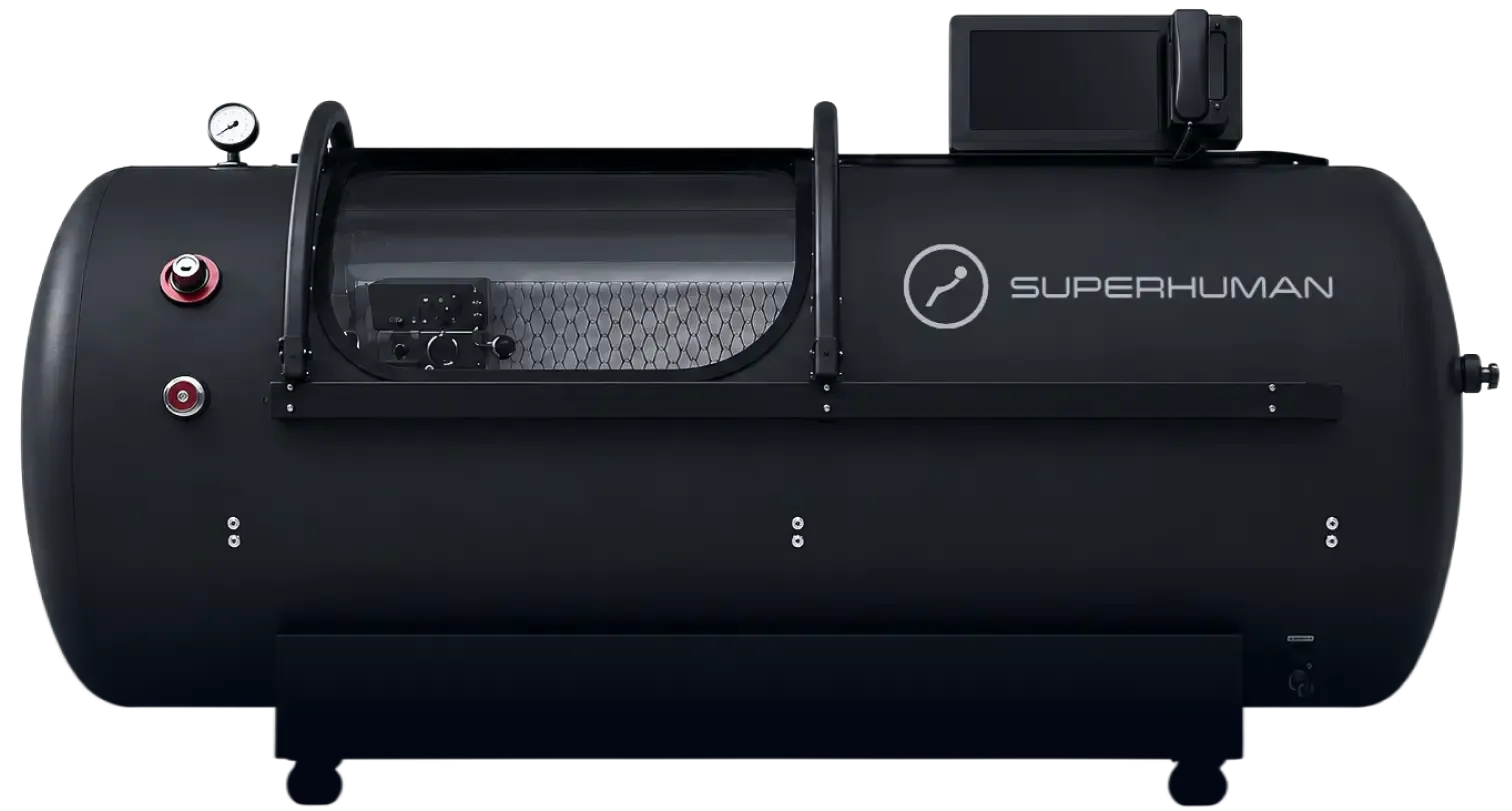 Single-person hard-shell Superhuman L1: 2.0 ATA, one occupant. Superhuman L1, from $49,900
 Scoping a chamber for a clinical or wellness operation? Book a consultation, or see the numbers in our financing and payments guide. For anything related to an actual ME/CFS patient, the path runs through a physician and the diagnostic criteria, not through equipment of any class.
The hardware facts
Engineering class, on paper.
Tap one for what it governs and which chambers it covers.
| A certification is not an outcome claim. What it says is narrower: the vessel is engineered, tested, and documented, and the soft shell in the last column is not the same class of equipment. That class difference is the only hardware point this page makes. |  |  |  |  |  |
|---|---|---|---|---|---|
| ASME PVHO-1 Vessels with a person inside. Starts at 2 psi. | Tested to ASME PVHO-1 standards | Tested to ASME PVHO-1 standards | Tested to ASME PVHO-1 standards | Tested to ASME PVHO-1 standards | Certification in progressListed here once issued. |
| ASME Section VIII Steel, thickness, welds. We hold the certificate. | Certified | Certified | Certified | Certified | Not applicableSoft shell, no steel pressure vessel. |
| ISO 13485 Medical device quality management. Entity, not chamber. | Applies to all of our chambers. | ||||
| ISO 9001 General quality management. | Applies to all of our chambers. | ||||
| CE / UKCA EU and UK market conformity. The manufacturer declares. | CE, PED | CE, PED | CE, PED, UKCA | CE | CE |
ASME PVHO-1 4 tested to, 1 pending
Vessels with a person inside. Starts at 2 psi.
- Superhuman T4 Tested to ASME PVHO-1 standards
- Superhuman T2 Tested to ASME PVHO-1 standards
- Superhuman X Tested to ASME PVHO-1 standards
- Superhuman L1 Tested to ASME PVHO-1 standards
- Superhuman S1 Certification in progress Listed here once issued.
ASME Section VIII 4 certified, 1 not applicable
Steel, thickness, welds. We hold the certificate.
- Superhuman T4 Certified
- Superhuman T2 Certified
- Superhuman X Certified
- Superhuman L1 Certified
- Superhuman S1 Not applicable Soft shell, no steel pressure vessel.
ISO 13485 5 certified
Medical device quality management. Entity, not chamber.
Applies to all of our chambers.
ISO 9001 5 certified
General quality management.
Applies to all of our chambers.
CE / UKCA 5 declared
EU and UK market conformity. The manufacturer declares.
- Superhuman T4 CE, PED
- Superhuman T2 CE, PED
- Superhuman X CE, PED, UKCA
- Superhuman L1 CE
- Superhuman S1 CE
Before the first session
Safety for the ME/CFS audience
HBOT has a real but manageable safety profile, and this page invents no ME/CFS-specific contraindications. What this audience adds is an exertion problem, an autonomic problem, and a medication problem, and all three are load-bearing.
The general profile is the standard one: ear barotrauma during compression is the most common problem, plus sinus pain, fatigue, temporary vision changes across long courses, and claustrophobia, especially in single-person chambers. The serious but rare risk is an oxygen-toxicity seizure, and the one absolute contraindication is an untreated pneumothorax (Heyboer 2017). The full picture is in our chamber safety guide and the side effects and contraindications guide. Certain medications and a small set of other conditions also rule the treatment out, which is why screening belongs to a clinician, not an intake tablet.
The ME/CFS-specific cautions on this page are about context, not invented physiology. PEM first: session frequency is an exertional variable, and the pacing plan belongs to a clinician who knows your baseline; the one published protocol that reported on this adjusted its schedule and had zero PEM dropouts, which is reassuring and still not a template for unsupervised packages (Kim 2026). Orthostatic intolerance is part of the diagnostic criteria (IOM/NAM 2015): many patients carry POTS or blood-pressure instability, so whoever screens you needs your autonomic history, not just your ears. The medication list matters: years of complex regimens and supplement stacks belong in a physician's review before anyone signs a package. The summary that matters: diagnosed first, screened, supervised, paced, and never instead of medical care, or not at all.
For wellness operators
What you can say, and what you must not claim
ME/CFS clients will find your chamber, and they will arrive more researched, more burned, and more exertion-limited than any other group you serve. The compliant answers are short, the referral is the product, and this audience has a long memory for who told them the truth.
| You can say | You must not claim | |
|---|---|---|
| Talking about ME/CFS | HBOT is not FDA-cleared for ME/CFS, no placebo-controlled trial has been completed, and the strongest direct evidence is a 30-patient uncontrolled cohort | That sessions cure, treat, or carry any published success rate for ME/CFS. There is no number you can honestly quote |
| Citing the research | Name the diagnosis on every study: the crossover trial was fibromyalgia, the randomized pair was long COVID, and the first ME/CFS sham trial is still recruiting | Presenting the Efrati fibromyalgia trial or the long-COVID RCTs as ME/CFS evidence. That is the industry’s most common misquote, and clients check |
| A client with severe fatigue | Ask whether they have a diagnosis, hand them the full record, and route them to a physician first; ME/CFS is a clinical diagnosis with common treatable mimics | Confirming a self-diagnosis, or any suggestion that a chamber package replaces the diagnostic workup |
| The exertion problem | Explain that post-exertional malaise is a core criterion of the illness, so session frequency and pacing belong in a clinician’s plan | Selling daily 40-60-session packages to a PEM-limited client as if the schedule were neutral. "Pushing through" is how ME/CFS patients crash |
One script covers the conversation that matters most. "I can barely get out of bed. Will this give me my life back?" The honest answer: nobody gets to promise that, and the published record for exactly your situation is four small studies with no placebo group, plus one rigorous sham-controlled trial that is still recruiting. There is no percentage I can quote you, and anyone who quotes you one should have to name the diagnosis in the paper. What we can do is show you the full record, and the first call after this one should be to the physician managing your care, about the diagnosis and about whether a daily-session schedule is safe for your PEM. An operator who says that out loud will lose some package sales and keep every bit of trust, and with this audience, people who compare notes in forums for years, trust is the only asset that compounds.
The patient's checklist
If you are considering HBOT for ME/CFS
Off-label does not mean off-limits; it means the burden of diligence moves to you. Here is the diligence, written for someone who has already done years of it.
Get the diagnosis position first
Before any chamber conversation, three physician questions. Is my diagnosis confirmed, against the IOM/NAM criteria, more than six months of substantial impairment, post-exertional malaise, unrefreshing sleep, plus cognitive impairment or orthostatic intolerance (the criteria). Have the mimics been ruled out: anemia, thyroid, sleep apnea, depression, diabetes, cardiac causes, because each is common and treatable, and the CDC estimates more than 9 in 10 people with ME/CFS were never properly diagnosed (CDC). And is my PEM stable enough for a daily schedule, because that is a medical question about your baseline, not a sales question. The FDA-indications side is mapped in our FDA-cleared indications guide.
Questions for the provider
Which protocol, exactly? Pressure in ATA, oxygen percentage, minutes at pressure, total sessions, and what it is extrapolated from; the honest answer is "uncontrolled studies at 2.0-2.5 ATA," and anything more confident is invention. What is the total itemized cost, in writing, including what happens to the balance if PEM forces you to stop at session fifteen. Who screens me: a clinician who knows what post-exertional malaise is and reviews your medications, or a waiver and a technician. And the question that separates honest providers from marketers: what do you tell patients the evidence actually is? One who answers "no completed controlled trials, one promising uncontrolled cohort, a sham trial recruiting now, and your doctor should know you are doing this" has done the reading. One who answers with a percentage has not.
Red flags, audited against the literature
"Studies prove HBOT works for CFS": ask which study; if the answer is Efrati, the patients had fibromyalgia (PMID 26010952). "A randomized trial showed benefit": the one randomized pilot gave HBOT to both groups and found nothing on its primary analysis (Van Hoof 2003). "Crashing after sessions means it is working": in ME/CFS, a crash is a crash; PEM is the defining symptom, not a detox sign. Any success percentage: no controlled denominator exists anywhere in this literature. A 1.3 ATA home unit sold with 2.0 ATA studies: a different, unstudied dose wearing the studied one's clothes. Pay-in-full-up-front packages: the standard cash-market pressure tactic, at its worst aimed at exactly this audience.
Honest edges
Limitations and open questions
Fairness cuts both directions on this page, and the direction that cuts against our own caution deserves to be stated as plainly as the other one.
Start there: absence of controlled trials is not proof of absence of effect, and this literature is not a wasteland. The Charite cohort is genuinely encouraging: rigorously diagnosed patients, measured improvements across symptoms and function, imaging changes that moved with them, and clean tolerability in the population whose tolerability was most in doubt. ME/CFS has no proven disease-modifying treatment, the disability is severe and documented, and the mechanism hypotheses are not fantasy. If the sham-controlled trial now recruiting reads out positive in 2027-2028, this page will need rewriting, and we will rewrite it gladly. That is the honest state of play: unproven is not disproven.
But the burden of proof sits on the seller, and two things keep it there. First, the field's own best experiment: when researchers finally ran a rigorous sham-controlled HBOT trial in the closest cousin condition, the sham group improved just as much (HOT-LoCO 2025), which is what uncontrolled fatigue numbers are made of. Second, the market's habit of borrowing evidence across diagnoses: fibromyalgia trials sold as CFS proof, long-COVID trials sold as ME/CFS proof, wellness-energy claims sold to people with a disabling illness. Until the ME/CFS sham trial reads out, the fair verdict is: investigational, untested against placebo, not covered, and never a substitute for diagnosis or a physician's care.
And one closing fact this page is built on. If an answer ever comes, it will come from clinical-class pressure with 100% oxygen under supervision, the 2.0 ATA dose class every datum on this page used, and it will not come from 1.3 ATA home units sold on borrowed biology. For the sharpest contrasts in this series, see the sibling Lyme pillar, where the direct literature is emptier still; the stroke pillar, where an uncontrolled literature finally met its sham-controlled test and lost; and the surgery recovery pillar, where a cleared exception sits next to an unproven market. ME/CFS is the page where the decisive experiment is finally on the calendar. We will update this page when it reads out.
FAQ
ME/CFS and HBOT questions
Is HBOT FDA-approved for ME/CFS?
No. Hyperbaric chambers are FDA-cleared for 13 indications (carbon monoxide poisoning, decompression sickness, non-healing diabetic wounds, radiation injury, and others), and ME/CFS is not among them. It is not a UHMS indication, Medicare does not cover it, and the NICE guideline for ME/CFS does not mention hyperbaric oxygen anywhere in its recommendations. Every ME/CFS use of HBOT is off-label and cash-pay. Any clinic page describing HBOT as an approved or proven ME/CFS treatment is misstating the record.
Are there any clinical trials of HBOT for ME/CFS?
As of October 2026, two studies are registered on ClinicalTrials.gov for ME/CFS and hyperbaric oxygen, and no placebo-controlled trial has ever been completed. The completed one is the Charite Berlin cohort behind the 2026 publication: 30 patients, 40 sessions, encouraging but uncontrolled. The second is the one that matters: NCT07621068, a randomized, double-blind, sham-controlled trial at the Sagol Center in Israel, 74 planned participants, 60 sessions at 2.0 ATA against a convincing sham, recruiting since July 2026 with completion estimated for June 2027. The published record behind those registrations is one randomized pilot with no placebo arm (Van Hoof 2003), one uncontrolled 16-patient series (Akarsu 2013), and one single-patient brain-scan report (Mairal 2021). That is the entire direct human literature.
The study I keep seeing cited, Efrati 2015, is that not proof?
It is a real trial, and it is not an ME/CFS trial. Efrati and colleagues enrolled 60 women diagnosed with fibromyalgia, a related but distinct condition with its own diagnostic criteria, and reported symptom improvement after 40 sessions at 2.0 ATA with brain-imaging changes. Fibromyalgia and ME/CFS overlap clinically, and the result is a legitimate reason to study ME/CFS, but a positive fibromyalgia trial is a hypothesis generator for ME/CFS, not evidence in it. When a competitor page cites this study as "CFS research" without naming the diagnosis, it is counting on you not to check the methods section. Now you have.
Long COVID improved in a randomized trial; is ME/CFS not the same thing?
They overlap but they are not the same cohorts, and the long-COVID evidence itself points in two directions. The 2022 sham-controlled trial in 73 post-COVID patients found significant improvements in cognition, energy, sleep, and pain. The 2025 HOT-LoCO trial, the most rigorous design yet in this space, randomized 80 long-COVID patients to 10 HBOT sessions or sham and found both groups improved, with no significant difference between them (p=0.87 on physical functioning). Neither trial enrolled ME/CFS patients; the Charite ME/CFS paper notes that only 77% of one long-COVID trial cohort even reported fatigue. The honest import of the pair is not "HBOT works" or "HBOT fails." It is that uncontrolled improvement is meaningless in fatigue conditions, which is exactly why ME/CFS now needs its own sham-controlled readout.
Does insurance cover HBOT for ME/CFS, and what does a course cost?
No. Medicare’s NCD 20.29 covers hyperbaric oxygen only for its listed indications, ME/CFS is not one of them, and commercial insurers follow the same line, so ME/CFS courses are cash-pay everywhere in the US. No clinic publishes ME/CFS-specific prices. For order of magnitude only: a 2026 systematic review reports per-session prices of $150-650 in the HBOT literature, and one clinic in the adjacent off-label brain-injury market has published $5,000-8,000 for a 40-session block. Published ME/CFS protocols ranged from a single treatment week to 40 sessions, and the registered sham trial uses 60, so a course lands anywhere from four figures to five. Get the total itemized cost in writing before the first session, and be wary of any package priced to be paid in full up front.
Is a home soft chamber the same treatment the studies used?
No. Every published human ME/CFS datum comes from clinical hard chambers at 2.0-2.5 ATA breathing 100% oxygen, and the sham trial now recruiting uses 2.0 ATA. Soft portable chambers operate around 1.3 ATA, typically fed by an oxygen concentrator rather than 100% medical oxygen, and their FDA clearance covers acute mountain sickness only. Dissolved plasma oxygen scales with pressure, so a mild home session is not a cheaper version of a studied dose; it is a different, completely unstudied one. ME/CFS patients are marketed 1.3 ATA home units precisely because daily home use sounds manageable with a chronic illness. The honest answer is that no equipment class, at any pressure, has controlled outcome data for ME/CFS, and a 1.3 ATA unit is the furthest of all from every dose that appears in the literature.
Last updated: October 2026. This guide is educational and is not medical advice. Hyperbaric oxygen therapy is not FDA-cleared for ME/CFS, and any ME/CFS use is off-label. ME/CFS is a clinical diagnosis made by a clinician against defined criteria after other causes are ruled out; never self-diagnose fatigue as ME/CFS, and never delay that workup. If you live with ME/CFS, any new treatment belongs in a conversation with the physician who knows your baseline, your PEM pattern, and your medications, including the honest fact of how thin the HBOT side of the record currently is.


