
Conditions · evidence guide
Hyperbaric Oxygen Therapy for Stroke Recovery: What the Evidence Shows
The most-cited positive trial had no sham control. The only sham-controlled trial was stopped early with results that exclude a clinically important benefit. A 2026 real-world study of 564 patients found no clinically meaningful effect. HBOT for stroke is investigational, not FDA-cleared, and cash-pay. Here is the full record, written for the families making this decision.
The short answer
Three verdicts, one page
Search results for HBOT and stroke blend three very different statements into one answer. Separating them is the whole story: what the hopeful evidence is and why it is weak, what the controlled evidence says, and where marketing outruns the literature.
The hopeful evidence, and its limits
One randomized crossover trial (Efrati 2013: 74 enrolled, 59 analyzed, 40 sessions at 2.0 ATA) found neurological gains years after stroke, and a retrospective series of 162 patients reported 86% improvement. But the crossover had no sham control, the 86% comes from a chart review with no comparison group, and every positive dataset traces to a single research group whose commercial arm sells the treatment.
The controlled evidence, and what it says
The only sham-controlled chronic-stroke trial (Harrison 2024) was stopped early with results excluding a clinically important benefit; the sham arm did better. A 2026 real-world study of 564 patients found no clinically meaningful effect. The Cochrane review of acute stroke calls HBOT an experimental therapy, and the one acute sham-controlled pilot read: not beneficial, possibly harmful.
Marketing that outruns the literature
Clinic pages calling stroke an "FDA approved" use (it is not), citing the wrong PMIDs, presenting other researchers' trials as their own work, listing a completed negative trial as "ongoing," and quoting "86% improvement" without mentioning there was no control group. This page audits those claims against the studies behind them.
Two disclosures frame everything below, and they belong at the top. First, HBOT is not FDA-cleared or approved for stroke: the cleared indications cover wounds, carbon monoxide poisoning, decompression sickness, and ten other conditions, and cerebrovascular disease is not among them (FDA, archived; UHMS indications). Every stroke treatment offered in the United States is off-label. Second, neither Medicare nor commercial insurers pay for it (NCD 20.29), which makes this a cash market aimed at families, and families deserve the whole record, not the highlight reel. New to the therapy itself? Start with how hyperbaric oxygen therapy works.
If someone is having a stroke, this page is not for that moment. Stroke is a time-critical emergency: know the signs (Face drooping, Arm weakness, Speech difficulty, Time to call 911) and call 911. Clot-dissolving drugs and thrombectomy work against hard clocks, and every minute of delay costs brain. HBOT has no role in the emergency, and the evidence says so twice over: in animal studies the benefit appears only when treatment starts within 30 to 60 minutes of onset, a window no real-world pathway can reliably hit, and starting later can make outcomes worse (Cozene 2020); and the one acute sham-controlled human pilot found the sham group doing better at 90 days (Rusyniak 2003). Everything else on this page concerns the chronic phase, months after the event, after standard care and rehabilitation have done their work.
Why oxygen became the hypothesis
The penumbra idea, in one honest paragraph
The mechanism story is genuinely elegant. It is also the story every clinic page leads with, so we keep it short and link you to the full version.
Most strokes are ischemic (a clot blocks a brain artery); the rest are hemorrhagic (a vessel bursts). In both, a core of brain tissue dies, but around it sits a larger zone, the penumbra, where cells are alive yet too starved of oxygen to function: researchers call them stunned or idling neurons. The HBOT hypothesis is that breathing 100% oxygen under pressure dissolves enough extra oxygen into blood plasma to reach those cells past the damaged vessels, and that repeated sessions across weeks can restart their activity and support the brain's own rewiring, neuroplasticity. That is the theory. It is plausible, it has imaging studies behind it, and it is not proof of benefit, which is exactly what the trial table in the next section is for.
One timing fact shapes the entire evidence debate: most spontaneous recovery after stroke happens in the first 30 to 90 days, which is why the chronic trials deliberately enroll people 6 to 36 months out, past the plateau, where gains would be surprising. It is also why a therapy marketed for that population must clear a high bar: the people buying it have usually finished rehabilitation and been told further improvement is unlikely.
The full mechanism story, the landmark-trial retelling, and the imaging case studies live in our stroke recovery research guide, which tells that side of the story properly. This page exists to grade it. For the related but separate brain-injury topic, see the TBI and HBOT evidence pillar: stroke is a vascular event with an emergency clock; traumatic brain injury is trauma, and the two literatures do not transfer.
The citations
The evidence, study by study
Every load-bearing claim on this page, mapped to the study behind it. The negative rows come first in our telling, because every clinic page puts them last or nowhere.
| Study | Design & population | Protocol | What it found | Level |
|---|---|---|---|---|
| Rusyniak et al. 2003 Stroke | Double-blind sham-controlled pilot, 33 acute ischemic stroke patients (within 24 h, no thrombolytics) | One 60-min session, 100% O2 at 2.5 ATA vs 1.14 ATA sham | No difference at 24 hours. At 90 days the SHAM group had more good outcomes on all four stroke scales (significant on three, lost in intent-to-treat). Authors: not beneficial, possibly harmful; declined a larger trial | Negative pilot RCT |
| Bennett et al. 2014 (Cochrane) Cochrane / Stroke synopsis 2015 | Systematic review, 11 RCTs, 705 participants, acute ischemic stroke | Adjunct HBOT vs no treatment or sham; protocols varied (1.5-2.5 ATA) | Early fatality RR 0.97 (95% CI 0.34-2.75): no difference. A few scale improvements, not consistent. Verdict: HBOT remains an experimental therapy for acute ischemic stroke; routine use cannot be justified | Cochrane review |
| Efrati et al. 2013 PLoS One | Randomized crossover trial, 74 enrolled, 59 analyzed, 6-36 months post-stroke, recovery plateaued | 40 sessions, 90 min, 100% O2 at 2.0 ATA, 5 days/week; cross group had a 2-month untreated control period first | Neurological function (NIHSS), daily living, and quality of life improved after HBOT in both groups; no improvement during the untreated control period; SPECT gains in live-but-low-activity regions. The control was no treatment, NOT a sham: placebo and expectancy cannot be excluded | Positive RCT (no sham) |
| Boussi-Gross et al. 2015 Neuropsychology | Retrospective analysis, 91 stroke patients, 3-180 months post-stroke, same research program | 40-60 daily sessions, 90 min, 100% O2 at 2.0 ATA | Statistically significant memory improvement with correlated metabolic imaging changes. Same single group, no randomization, no control arm | Retrospective (no control) |
| Hadanny et al. 2020 Restor Neurol Neurosci | Retrospective analysis, 162 chronic stroke patients (>3 months), treated 2008-2018, NO control group | 40-60 daily sessions, 90 min, 100% O2 at 2.0 ATA with air breaks | All cognitive domains improved; 86% reached clinically significant improvement (>0.5 SD). The most-quoted vendor statistic in this market, and it has no comparison arm: everyone in the series chose and paid for treatment | Retrospective (no control) |
| Schmutz et al. 2023 Clin Transl Neurosci | Prospective single-arm feasibility study, 13 recruited, 10 completed, 4-251 months post-stroke | 40 daily sessions at 2.0 ATA | Feasible and well tolerated, no serious adverse events. 8 of 10 completers improved NIHSS by a mean of 1.3 points, below the 2-point clinically important difference. Three of 13 dropped out over travel logistics alone | Feasibility (tiny) |
| Harrison et al. 2024 Cureus | The only sham-controlled chronic-stroke RCT. 6-36 months post-ischemic stroke. Stopped early at 34 of 136 planned after recruitment failure and a mid-trial control-arm redesign | 40 sessions of 90 min at 2.0 ATA vs a sham designed to replicate the HBOT experience (the Efrati dose) | Primary outcome SIS-16 differed by 5.5 points (95% CI 1.3-9.7, p=0.01) IN FAVOR OF THE SHAM GROUP. Authors: results exclude a clinically important benefit and do not support HBOT in chronic stroke survivors. Underpowered, but the only data of its kind, and it points the other way | Negative sham RCT |
| Zhang et al. 2026 J Neurorestoratology | Real-world retrospective cohort, 564 patients (14 days-6 months post-stroke), propensity score matching and inverse probability weighting | 15-40 HBOT sessions at 1.8 ATA plus routine rehab vs routine rehab alone (250 vs 314) | After matching (83 pairs): no significant difference on any functional outcome. Weighted analysis: a statistically significant NIHSS reduction (beta -0.3428, p=0.040) that is well below the 2-point minimal clinically important difference. Subgroup completing 15-24 sessions did better (interaction p=0.004), hypothesis only | Null real-world study |
PMIDs, DOIs, and links for every row are in the sources card. The synthesis: the positive signal is real but comes from uncontrolled or sham-free designs inside one research group; the two most rigorous datasets (the only sham-controlled chronic trial, and the largest real-world analysis) both failed to find a clinically meaningful benefit. That is the state of the evidence in September 2026, and any page telling you otherwise is selecting its studies.
The control-group problem, explained
Why does the design detail matter so much? Because this therapy is sold to motivated families in a setting built for hope: a high-tech chamber, attentive staff, daily ritual for two months, and a large bill that everyone wants to be worth it. In that environment, placebo and expectation effects are large, and only a sham control can separate them from the treatment. Efrati's crossover trial compared HBOT against no treatment, so patients knew exactly when they were being treated. The Hadanny series had no comparison group at all. Both designs can produce real, measurable improvement that still is not caused by the oxygen. This is the same methodological fight that played out in the TBI literature, where trials with weak shams read null for a decade before a true-sham design finally gave a clean answer. Stroke is waiting for its equivalent.
The provenance problem, stated once
Every positive chronic-stroke dataset you will read about, the Efrati trial, the memory study, the 162-patient series, the imaging case reports, comes from one research program, the hyperbaric institute at Assaf Harofeh Medical Center and the Sagol Center in Israel. That group does serious work, and it also has a commercial arm, Aviv Clinics, that sells the treatment program those studies support. None of that makes the data false. It makes independent replication the whole ballgame, and the one independent group that ran a proper sham-controlled replication, the University of British Columbia team behind Harrison 2024, could not reproduce the benefit. When you read a stroke-HBOT headline, the first question worth asking is: whose study is it, and has anyone outside that group confirmed it?
The decision math
What a course actually involves
For a family weighing this for a parent or spouse, the protocol is not a detail. It is the decision: time, money, logistics, and who is even a plausible candidate.
The protocol, in numbers
The studied chronic protocol is 40 to 60 sessions, 60 to 90 minutes each, at 1.5 to 2.0 ATA breathing 100% oxygen, five days a week, for eight to twelve weeks. The flagship trial used 40 sessions of 90 minutes at 2.0 ATA, and the sham-controlled replication matched it exactly. This is not a course you squeeze around life; it reorganizes life for two to three months. The Swiss feasibility study, run on mobile, mildly affected survivors, still lost 3 of 13 participants to travel logistics alone (Schmutz 2023). For a survivor with mobility limits, the daily commute falls on the family as much as on the patient.
The money, in the open
Because stroke is off-label, the market is cash-pay, and no major US stroke-HBOT clinic publishes its prices. The only public figure in the adjacent off-label brain-injury market is one clinic's published $5,000 to $8,000 for a 40-session block; treat that as an order of magnitude, not a quote, and note that premium multidisciplinary programs built around HBOT cost more than chamber time alone. The rules that protect a family: get the total itemized cost in writing before the first session, ask what happens to the balance if you stop at session twelve, and be suspicious of any package priced to be paid in full up front. How coverage works for the indications that are covered is mapped in our insurance coverage guide.
Who is even a candidate
The trials screened carefully, and a responsible clinic does the same. The recruiting US trial excludes people with recent seizures, hemorrhagic transformation, significant lung disease, and communication deficits that prevent following safety instructions (NCT06148285). Add the practical filters: medically stable, able to sit upright for 90 minutes, able to equalize ear pressure, able to commute daily. A survivor with post-stroke epilepsy, severe aphasia, or advanced frailty is not a candidate for this market at any price, and a clinic that enrolls them anyway has told you what it is.
The timing question, reconciled
Vendor advice conflicts here, so here is the honest version. One leading clinic tells families to wait 3 to 6 months before starting. The biology says most natural recovery happens in the first 90 days anyway. Put together: by the time anyone offers you this treatment, the steepest free gains are behind you, which cuts both ways. Improvement at month eight is less likely to be spontaneous, so a real effect would mean something, but it is also precisely the population where the only sham-controlled trial failed to find one. There is no version of the evidence where earlier or urgent is better. Anyone pushing urgency in chronic stroke is selling, not advising.
The equipment side
What the studied dose requires
Every number in the evidence table was produced by a specific class of equipment. Understanding that class matters more than any brand name, so here is the dose, then the hardware category, with zero outcome claims attached.
The chronic-stroke literature ran on hard-shell chambers delivering 100% oxygen through a mask or hood at 1.5 to 2.0 ATA: the Efrati and Harrison trials used multiplace clinical chambers at 2.0 ATA, and the acute pilot used a monoplace unit at 2.5 ATA. Dissolved plasma oxygen, the proposed mechanism of the entire therapy, scales with that pressure. Soft portable chambers operate around 1.3 ATA, typically fed by an oxygen concentrator rather than 100% medical oxygen, and their FDA clearance covers acute mountain sickness only. A soft-chamber session is not a cheaper version of the studied dose; it is a different, unstudied dose. Our own soft-shell S1 (1.3-1.5 ATA, concentrator-fed) sits in that class, and we do not present it as the studied stroke dose. The regulatory and engineering details live in our medical-grade chambers explainer, the ATA pressure guide, and the chamber pressure levels guide, and the soft-versus-hard hardware comparison is in the soft-shell chamber guide.
For clinics and operators evaluating a neuro-adjacent recovery program, the equipment-class takeaway is narrow and factual: the pressures the stroke trials used sit in hard-shell, medically engineered territory, with certified pressure vessels, documented oxygen delivery, and trained oversight. The single-person rung of that class in our lineup is the Superhuman L1 (2.0 ATA hard-shell, from $49,000), with the two- and four-person models shown below. Our chambers are built to that engineering class, which is the only claim we make here, and it is a claim about hardware, not about treating stroke.
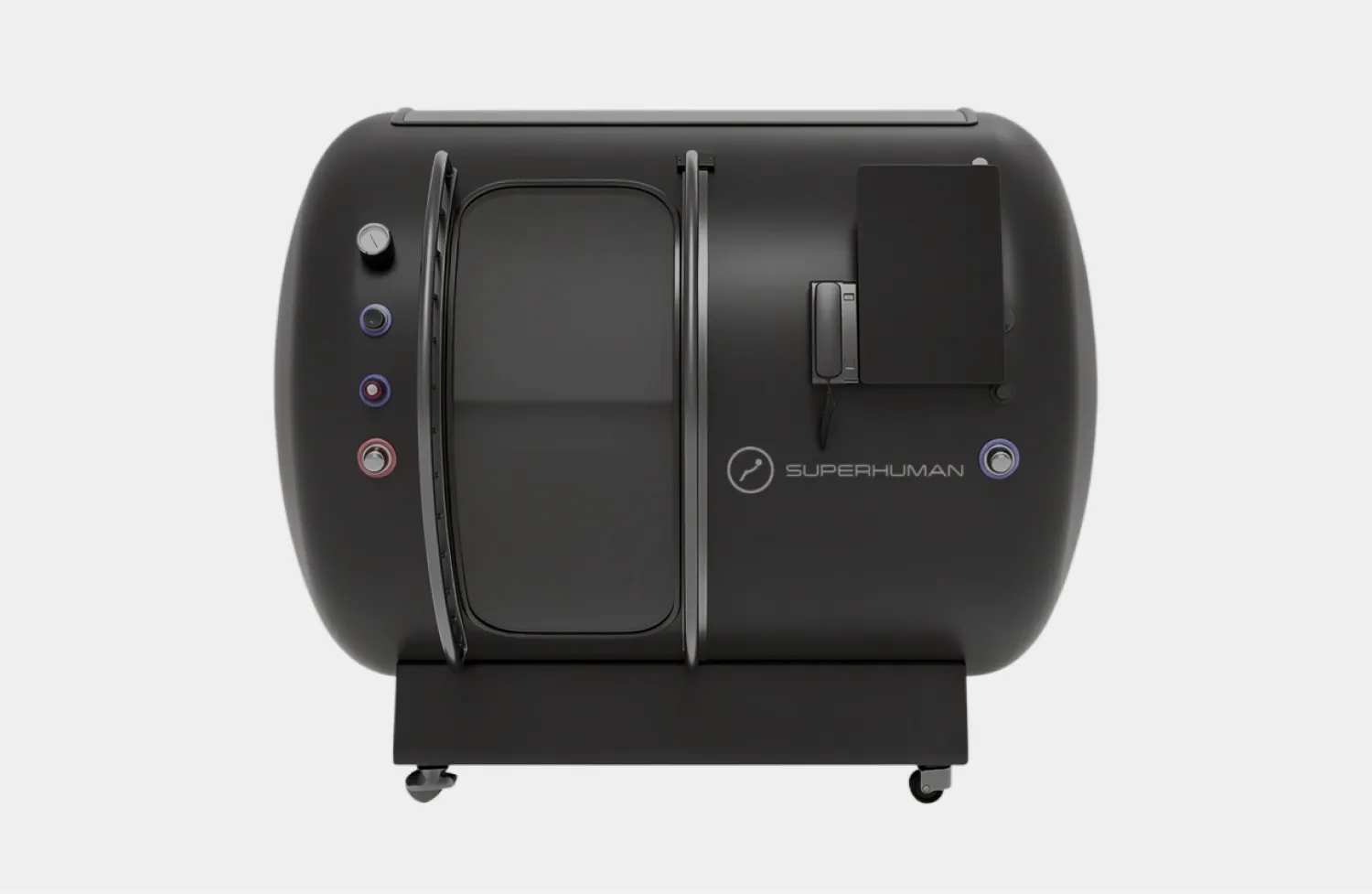
Superhuman T2: 2.0 ATA hard-shell, ASME and PVHO-1 tested, built in an ISO 13485 medical-device facility
Superhuman T2, from $125,000 →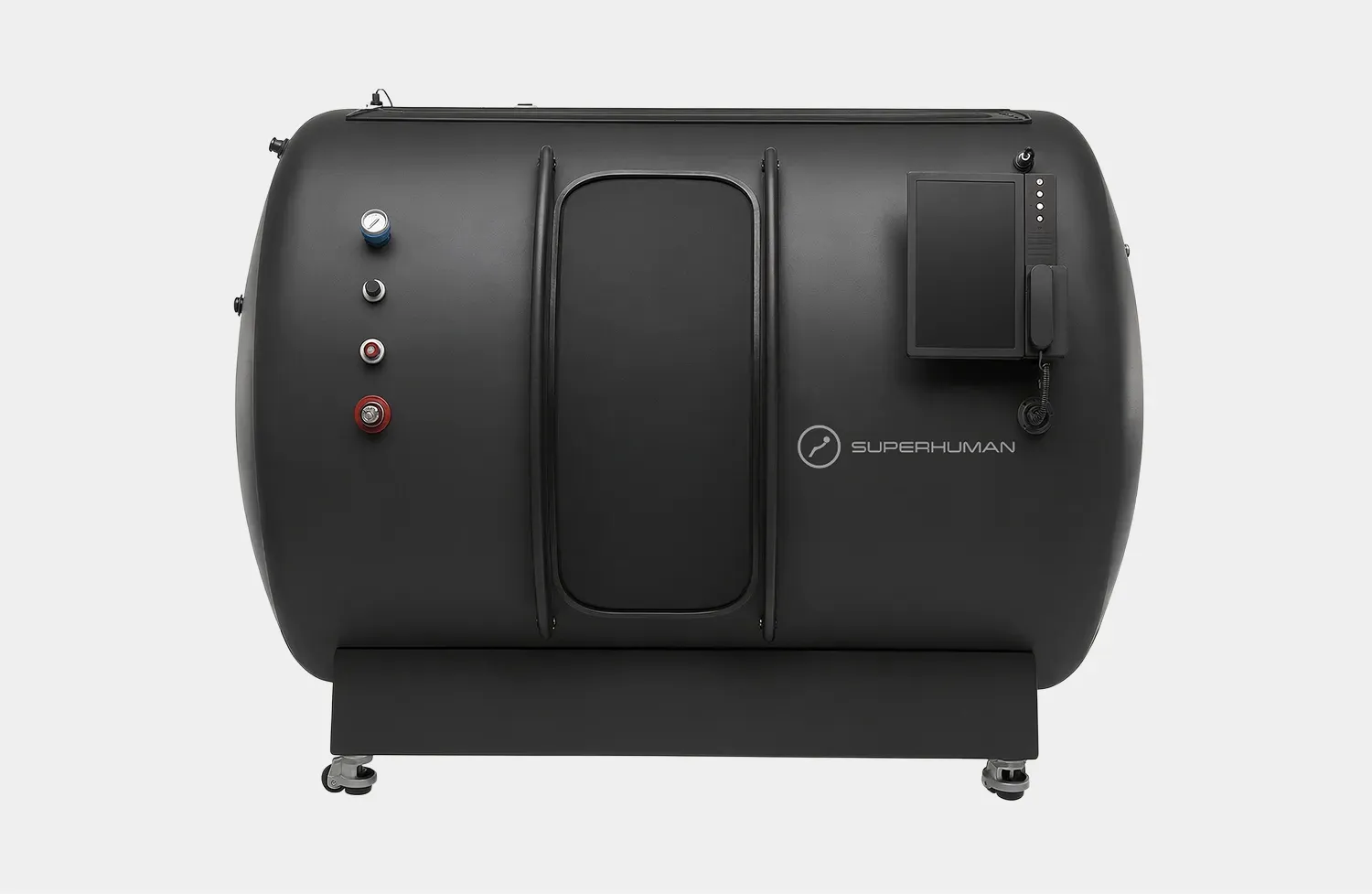
Superhuman T4: 2.0 ATA hard-shell for four occupants, ASME-certified vessel, clinical-scale throughput
Superhuman T4, from $169,000 →Scoping a chamber for a clinical or wellness operation? Book a consultation, or see the numbers in our financing and payments guide. For anything related to an actual stroke survivor, the path runs through a physician, not through equipment of any class.
Before the first session
Safety in stroke survivors
HBOT has a real but manageable safety profile, and the stroke population, older, often on multiple medications, sometimes with seizures or communication deficits, carries specific cautions on top of the general ones.
The common side effects are mundane: ear barotrauma during compression, sinus pain, temporary vision changes across long courses, fatigue, and claustrophobia, especially in single-person chambers. The serious risk the literature tracks is oxygen-toxicity seizures, and here pressure matters directly: in one large series, seizures ran at zero observed at 2.0 ATA, 15 per 10,000 treatments at 2.4-2.5 ATA, and 51 per 10,000 at 2.8 ATA (Heyboer 2015), one reason the chronic stroke protocols sit at 2.0 ATA. The one absolute contraindication is an untreated pneumothorax. Both human stroke trials that monitored it confirm the treatment is mechanically well tolerated in screened survivors.
Stroke adds its own list. Post-stroke seizures change the risk-benefit math for any oxygen-toxicity event and exclude patients from the trials themselves. Communication deficits matter practically: a survivor with aphasia cannot report ear pain or rising anxiety, which is why the recruiting trial screens them out. Mobility and transfer limits turn the daily commute into the family's problem. Anticoagulation and cardiovascular burden are routine in this population and belong in a physician's review, not a technician's intake form. The full contraindication picture is in our chamber safety guide. The summary that matters: screened, supervised, and physician-led, or not at all.
For wellness operators
What you can say, and what you must not claim
Families of stroke survivors will find your chamber, often months after rehab ended, still hoping. The compliant answers are short, the referral is the product, and staying inside these lines protects the family and the business.
| You can say | You must not claim | |
|---|---|---|
| Talking about stroke | HBOT is not FDA-cleared for stroke; the controlled evidence is mixed to negative and research continues | That hyperbaric sessions restore movement, speech, or cognition after stroke. No outcome claims, ever |
| A family asks for a parent | Hand them the full trial record, including the negative studies, and point them to the survivor's physician | Quoting the "86%" cohort figure, wheelchair-to-walking stories, or any recovery percentage |
| Pressure honesty | State your chamber's rated pressure and that the stroke trials used 1.5-2.0 ATA with 100% oxygen under supervision | Citing stroke trial results as if they were produced in your studio's protocol |
| Any suspected stroke | Call 911. Minutes decide outcomes; thrombolytics and thrombectomy are the evidence-based race | Any role for a wellness chamber in acute stroke. None exists |
One script covers the conversation that matters most. "My husband had a stroke last year and stopped improving. Will this bring him back?" The honest answer: nobody gets to promise that, and the most careful trial ever run on exactly that question found no meaningful benefit. What we can do is show you the full study record, including the negative ones, and suggest you bring it to his neurologist, and if you want to try this inside real science, there is a sham-controlled trial that costs nothing. An operator who says that out loud will lose some sales and keep every bit of trust, and with this audience, trust is the only asset that compounds.
The family's checklist
If your family is considering HBOT after a stroke
Off-label does not mean off-limits; it means the burden of diligence moves to you. Here is the diligence, in checklist form, written for the person doing the research at 11 pm.
What to ask a provider
Which protocol, exactly? Pressure in ATA, oxygen percentage and delivery, minutes at pressure, total sessions. The studied dose is 100% oxygen at 2.0 ATA for about 90 minutes, 40 times; anything materially different is an extrapolation the provider should own out loud. Who is the physician? A named doctor who screens for seizures, lung disease, and stability, or a waiver and a technician. What is the total itemized cost, in writing, including what happens if you stop early. And the question that separates honest clinics from marketers: how do they read Harrison 2024 and the 2026 real-world study? A provider who knows the only sham-controlled trial came out negative, and can discuss it without flinching, has done the reading. One who has never heard of it has not.
Red flags, audited against the literature
"FDA approved for stroke": false, and we found it in a clinic page's own metadata; stroke is off-label everywhere in the US. "86% of patients improved": a real number from a retrospective series with no control group (Hadanny 2020), where every patient chose and paid for treatment; without a comparison arm it cannot tell you what the treatment added. Clinics presenting other researchers' trials as their own: we found the Israeli trials attributed to an unrelated US clinic. Wrong PMIDs and "ongoing" trials that finished negative: we found both; the UBC trial one clinic lists as upcoming is Harrison 2024, completed, and its result is in our table. Guaranteed recovery, and urgency pressure: the evidence supports neither, ever.
The route most families miss: clinical trials
The most genuinely hopeful, honest path is also the cheapest. A sham-controlled trial is recruiting now in New Orleans: acute ischemic stroke, 7 to 30 days post, inpatient rehabilitation, three arms including a true low-pressure air sham, no cost to participants, monitored throughout (NCT06148285, n=120, LCMC Health). Two large post-thrombectomy HBOT trials are also recruiting in China. Whatever your family concludes about HBOT, the trials are where the honest answer gets written, and ClinicalTrials.gov is the only marketplace where the treatment is free.
Honest edges
Limitations and open questions
The evidence is real where it is real and contested where it is contested. Both halves deserve the same clarity, including the parts that cut against the negative.
Start with the weaknesses in the negative case, because fairness demands it. Harrison 2024 was badly underpowered: 34 of a planned 136 participants, a control arm redesigned mid-trial, a single center. A broken trial cannot prove the therapy fails any more than a biased one can prove it works. Zhang 2026 was retrospective and used 1.8 ATA, not the 2.0 ATA the positive trials used, and its one intriguing subgroup (patients completing 15 to 24 sessions, interaction p=0.004) is exploratory, not confirmatory. The honest summary is not "HBOT does not work." It is: the uncontrolled evidence says benefit, the controlled evidence so far says no, and nobody has run the definitive trial yet.
The weaknesses in the positive case run deeper, though. The entire hopeful literature clusters in one research group, whose commercial arm sells the treatment; the flagship trial let patients know when they were being treated; the largest series had no comparison group; and the most-quoted statistic in the market, 86%, comes from that series. None of this is scandalous. All of it is exactly the pattern that demands independent, sham-controlled replication before a family spends five figures.
What would settle the question is known and, for once, actually happening: adequately powered, multicenter, true-sham trials with standardized outcomes, the design now recruiting in New Orleans and in two large Chinese programs. Until they report, the fair verdict for a family is: investigational, unproven, not covered, and not urgent. And one closing fact this page is built on: whatever the answer becomes, it will be decided at medical-grade pressure with 100% oxygen under physician supervision, the dose class every trial on this page used. For the indication where HBOT is already established, covered, and guideline-backed, see the sibling wound healing and HBOT pillar. The contrast between the two pages is the most honest sentence we can write about this one.
FAQ
Stroke and HBOT questions
Is HBOT FDA-approved for stroke?
No. Hyperbaric chambers are FDA-cleared for 13 indications (carbon monoxide poisoning, decompression sickness, non-healing diabetic wounds, radiation injury, and others), and stroke is not among them. Every stroke use of HBOT in the United States is off-label. The American Heart Association's own journal summarized the evidence in 2015 as: HBOT remains an experimental therapy for acute ischemic stroke. A clinical reference service used by hyperbaric physicians classes stroke as an off-label, less-plausible indication and notes that hospital-based clinics generally cannot treat it without risking their Medicare standing. Any clinic page describing stroke HBOT as approved or proven is misstating the record.
Does insurance or Medicare cover HBOT for stroke?
No. Medicare's National Coverage Determination 20.29 covers hyperbaric oxygen therapy only for its listed indications, and stroke is not one of them; commercial insurers follow the same line, so stroke courses are cash-pay. No major US stroke-HBOT clinic publishes its prices online, which is itself worth noting. In the adjacent off-label brain-injury market, one clinic has published figures of $5,000-8,000 for a 40-session course; treat that only as an order of magnitude and demand a written, itemized quote before committing. Our insurance coverage guide, linked on this page, explains how the covered indications work.
Can HBOT help years after a stroke?
That is exactly the population the chronic trials studied, and the honest answer is: the uncontrolled data says maybe, the controlled data says no. The positive results years after stroke come from one research group's trials without sham controls. The only trial that used a real sham control (Harrison 2024) found the sham group doing better, and a 2026 real-world study of 564 patients found no clinically meaningful effect. This is investigational territory. If your family wants to explore it, the most defensible routes are a physician conversation and the recruiting sham-controlled trials, which cost nothing and are monitored. Our stroke research guide, linked on this page, tells the hopeful side of the story in full; this page exists so you can weigh both.
How many sessions did the studies use, and what does a course involve?
The chronic-stroke protocols cluster tightly: 40 to 60 sessions, 60 to 90 minutes each, at 1.5 to 2.0 ATA breathing 100% oxygen, five days a week, so eight to twelve weeks of daily attendance. The Efrati trial used 40 sessions of 90 minutes at 2.0 ATA, and Harrison's sham-controlled trial matched that dose exactly. The burden is the point for families: this is a daily commute for two to three months. The Swiss feasibility study lost 3 of 13 patients to travel logistics alone. Before paying, ask for the protocol in writing, the total itemized cost, and whether the facility has ever told a family it was not a good candidate.
Is a home soft chamber the same treatment the trials used?
No. Every chronic-stroke trial used a hard chamber delivering 100% oxygen at 1.5-2.0 ATA through a mask or hood, under supervision. Soft portable chambers operate around 1.3 ATA, typically fed by an oxygen concentrator rather than 100% medical oxygen, and their FDA clearance covers acute mountain sickness only. Dissolved plasma oxygen, the proposed mechanism, scales with pressure, so a mild-pressure home session is a different, unstudied dose, not a cheaper version of the same one. If a seller quotes the stroke trials while proposing a soft home unit for your parent, ask which trial was run at that pressure.
Should HBOT replace rehabilitation after a stroke?
No, and even the researchers reporting positive results say so. Every chronic-stroke study delivered HBOT alongside or after structured rehabilitation, and the rehab literature is clear that repetitive, task-specific practice is what drives neuroplastic recovery. The fairest current framing is: rehabilitation is the treatment with evidence behind it; HBOT is an investigational adjunct whose best-controlled tests have so far come out negative. A family that budgets energy and money should fund the proven thing first, and any clinic that suggests pausing physical, occupational, or speech therapy in favor of chamber sessions has the order backwards.
Last updated: September 2026. This guide is educational and is not medical advice. Hyperbaric oxygen therapy is not FDA-cleared for stroke, and any stroke use is off-label. A suspected stroke is a medical emergency: call 911 first, always; standard care saves the brain that later decisions are about. Any choice about HBOT for a stroke survivor belongs with that person's treating physicians, who can weigh it against their history, their imaging, and the full trial record, positive and negative.