Designing the room
Home wellness room
A home wellness room is a dedicated recovery space built around one anchor device, and in 2026 that anchor is the hyperbaric chamber. Zillow links cold plunges to a 2% sale premium. Below: the layout, the infrastructure table, and three honest budgets.
The 2026 tipping point
What a home wellness room is, and why now
A home wellness room is a dedicated space for recovery modalities: a hyperbaric chamber, a sauna, a cold plunge, red light, compression, and a quiet corner, assembled in one room and used on a schedule. It is not a home gym. A gym is built around exertion; a wellness room is built around what happens after exertion, and the distinction matters because the equipment, the flooring, the lighting, and even the electrical plan are different.
The category crossed a threshold this cycle. The Associated Press has documented wellness rooms claiming square footage that used to go to formal dining rooms and media rooms, and Business Insider has declared the man cave era over in favor of recovery space. The money followed: the cold plunge market alone is projected to grow from $355 million to $660 million within the decade, and Zillow's analysis of millions of listings found that homes mentioning a cold plunge sell for about 2% more than expected.
Remote work is the quiet driver underneath all of it. When the commute disappears, the spare bedroom stops being a guest room used twice a year and becomes the most valuable underused square footage in the house.
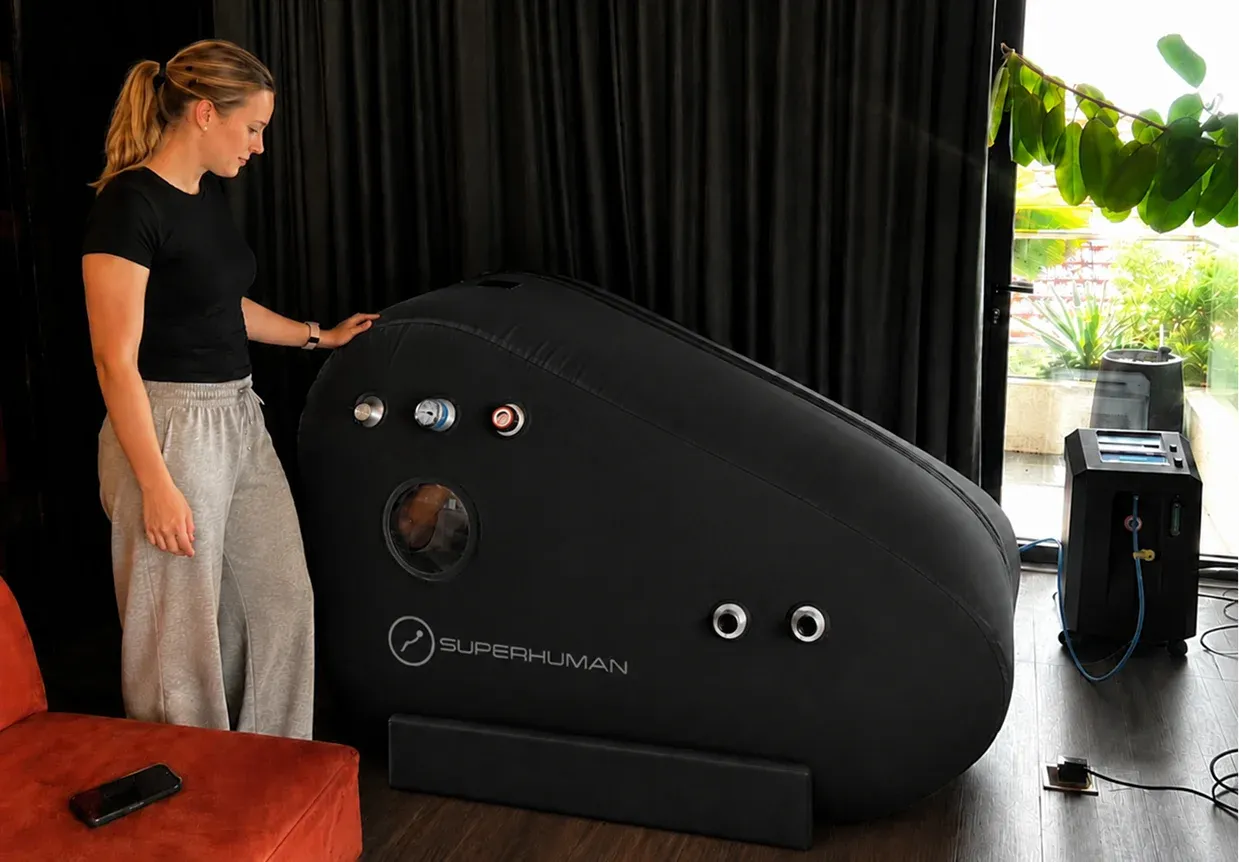
Design around the anchor
Start with the anchor: why the hyperbaric chamber comes first
Every other modality in the room tolerates improvisation. The chamber does not, and that is exactly why it goes on the plan first.
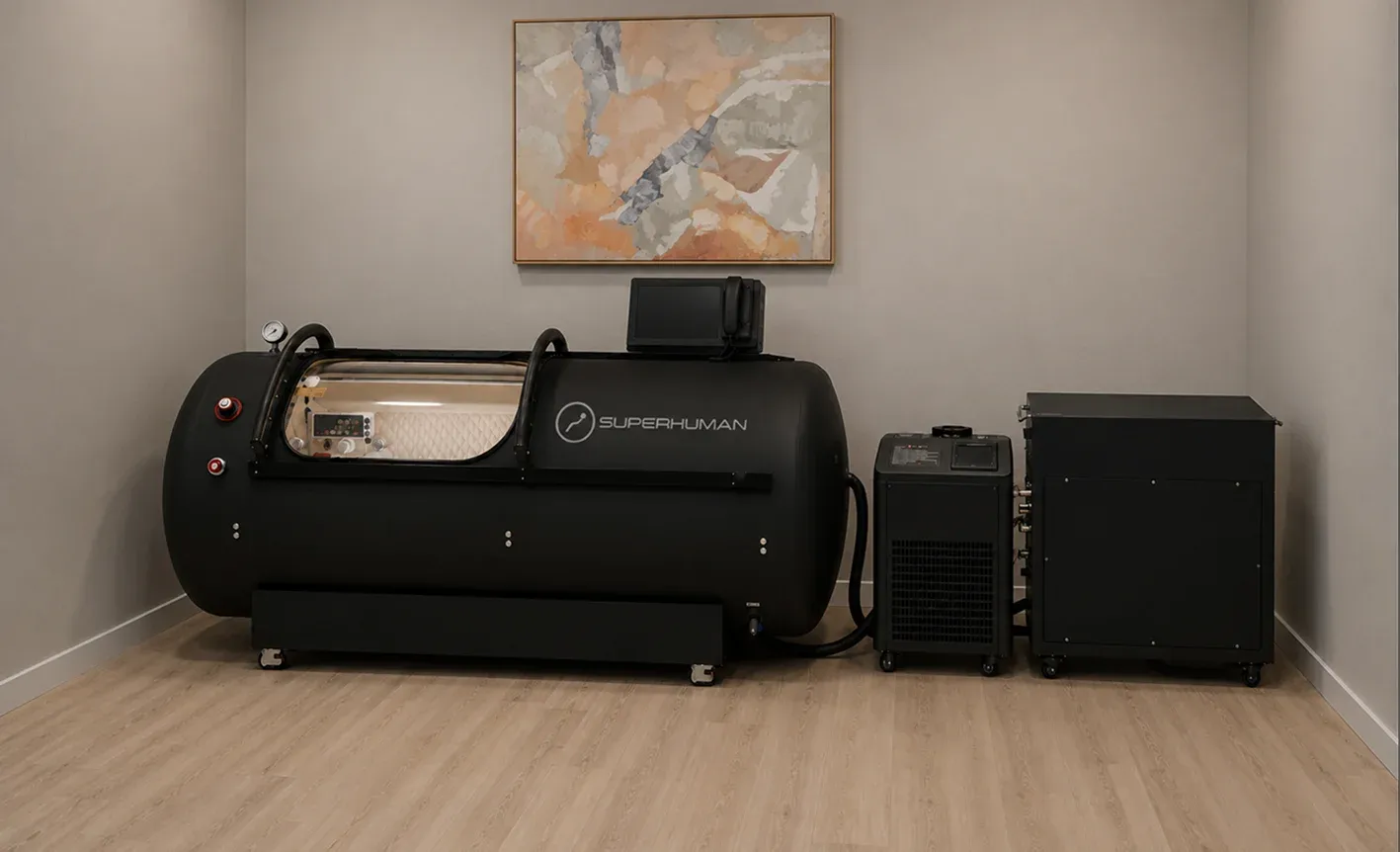
The chamber is the largest single investment in the room, typically 50 to 70% of the total budget, and it dictates everything downstream: where the floor load sits, where the compressor and its noise live, how wide the delivery path must be, and how much clearance the layout owes it. A sauna can slide into a corner. A plunge can move six feet. A hard-shell chamber, once placed, is the room's fixed point, so the layout, the wet and dry zones, and the circulation path all get drawn around it.
There is a second reason, and it is behavioral. The anchor is the modality you will use most, because it has the lowest session friction: lie down, zip or seal, pressurize, and read, work, or take a call for 60 to 90 minutes. The seated Superhuman X ($79,900, 2.0 ATA) is built for exactly this workflow: you sit upright and take the workday into the session with you. A room designed for consistency puts its zero-friction device in the most visible, most accessible position. Our guide to home hyperbaric chambers covers who buys one and why daily access is the entire point.
A short pressure literacy is essential before you plan around one. Chamber pressure is measured in ATA, atmospheres absolute. Soft-shell chambers run 1.3 to 1.5 ATA (mild HBOT); hard-shell chambers reach 2.0 ATA, the pressure used in most studied protocols. The full breakdown lives in pressure levels explained, and the construction trade-offs in hard-shell vs soft-shell chambers.
One regulatory note belongs in a homeowner's planning: hyperbaric chambers are FDA-regulated Class II medical devices. The FDA has cleared HBOT for specific medical indications, and the Undersea and Hyperbaric Medical Society (UHMS) publishes the recognized indication list. Wellness and performance use at home is a separate, widely practiced category, and it should still be run under appropriate medical guidance, which we cover in the safety section below.
The supporting ring
The supporting circuit: sauna, cold plunge, red light, compression
Once the anchor is placed, four modalities complete the circuit. Each earns its floor space with a different job, and they chain into a single contrast-therapy sequence.
Size, layout, zoning
Planning the room: space and flow
Plan on 12' × 12' (about 144 sq ft) as the practical minimum for a chamber plus two supporting modalities, and 15' × 20' for the full circuit with a shower. A spare bedroom, a basement corner, or a two-car garage bay all convert well; what matters is not the room type but the delivery path and the zoning.
Zoning is the one layout decision you cannot undo. Split the room into a wet zone (plunge, shower, traditional sauna: waterproof flooring, floor drain, vapor-managed walls) and a dry zone (chamber, red light, compression, seating). The sauna door should open within a few steps of the plunge, because contrast therapy is a walk, not a commute. The chamber sits in the dry zone with clear floor around its entry end.
Materials do double duty. Cork, rubber, or sealed concrete in the wet zone; warm wood or acoustic panels in the dry zone; dimmable, layered lighting at 2700K or warmer, because this room's job includes downshifting your nervous system. Sound absorption matters more than people expect: a room with a compressor, a chiller, and water movement benefits from every soft surface you give it.
The spec sheet nobody publishes
Infrastructure: power, ventilation, drainage, floor load, and noise
This is the table the rest of the internet skips. Every modality, one row each, with the six infrastructure questions that decide whether your room works. Planning ranges for residential-grade equipment: confirm final figures with the manufacturer and a licensed electrician before rough-in.
| Modality | Footprint | Power | Floor load | Ventilation | Noise | Drainage |
|---|---|---|---|---|---|---|
| Infrared sauna (2-person) | about 4' × 4' | 110V, 15 to 20 A dedicated | low, about 400 to 600 lb total | minimal, passive vent | silent | none |
| Traditional sauna (4-person) | about 6' × 6' | 220V, 30 to 60 A dedicated | moderate, about 800 to 1,200 lb | required, intake + exhaust | silent (heater ticks) | recommended floor drain |
| Cold plunge + chiller | about 2.5' × 6' | 110V, 15 A dedicated | high, 800 to 1,200 lb filled (water is 8.34 lb per gallon) | moderate, manages condensation | 45 to 60 dB chiller cycle | required, floor drain or pump |
| Red light panel | wall-mounted | 110V standard outlet | negligible | none | quiet fan | none |
| Compression system | armchair footprint | 110V standard outlet | negligible | none | about 40 dB pump pulses | none |
| Soft hyperbaric chamber | under 1.8 m long inflated, folds for storage | 110V standard outlet + concentrator | low | one ventilated room is enough | quiet operation | none |
| Hard hyperbaric chamber | from about 1.7 m long, plus access clearance at both ends | 110V standard outlet + concentrator | high, a steel vessel concentrated on contact points; confirm the structure | dedicated air-exchange planned with the installer | quiet operation, conversation level, best placed in an adjacent closet | none |
Power: the surprise is what does not need a special circuit. The chamber and its concentrator, the chiller, red light, and compression all run on standard 110V outlets, each on its own dedicated line as good practice. Only the traditional sauna heater demands 220V and a 30 to 60 amp breaker.
Noise: the two sound sources are the chamber's compressor and the plunge's chiller, both around conversation level. The professional move is placement, not silence: a compressor in an adjacent closet with a solid door reads as a faint hum from inside the room.
Delivery: a hard-shell chamber arrives as the largest single object you will ever bring into a home. Measure every doorway, hallway, and stair turn on the path before ordering; 36 inches of clear width is the working rule, and tight turns matter as much as width. Both hard-shell models in our lineup, the L1 and the X, ship white-glove, and we map the route with you before anything ships.
The money question
What a home wellness room costs: three honest budgets
The question the design media refuses to answer with numbers. Three complete rooms at three price points, including the chamber.
| Line item | Tier 1 · Essential | Tier 2 · Performance | Tier 3 · Flagship |
|---|---|---|---|
| Hyperbaric chamber | not yet | Soft-shell, 1.3 to 1.5 ATA, from $15,000 | Hard-shell, 2.0 ATA, from $49,900 (seated flagship $79,900) |
| Sauna | Infrared cabin, $3,000 to 6,000 | Premium infrared or compact traditional, $6,000 to 12,000 | Custom traditional sauna built in place, $15,000 to 30,000 |
| Cold plunge | Insulated tub + ice, $1,000 to 3,000 | Chiller-based plunge, $5,000 to 10,000 | Chiller-based plunge, $8,000 to 15,000 |
| Red light, compression, mobility | $1,000 to 2,000 | $2,000 to 4,000 | $3,000 to 6,000 |
| Room build-out (electrical, flooring, drainage, lighting, acoustics) | $2,000 to 4,000 | $10,000 to 20,000 | $30,000 to 60,000+ |
| All-in | about $10,000 | about $60,000 | $150,000 and up |
Tier 1 buys the habit: contrast therapy and light, no chamber yet, and a room laid out so the anchor drops in later without rework. Tier 2 is where most longevity buyers land: a soft-shell chamber from $15,000 plus the full supporting circuit. Tier 3 is the permanent installation: a hard-shell from $49,900 built into a finished room with drainage, ventilation, and acoustic treatment.
In our lineup those anchors are the Superhuman S1 (soft-shell, 1.3 to 1.5 ATA, $15,000) in Tier 2 and the Superhuman L1 (hard-shell, 2.0 ATA, $49,900) in Tier 3, with the seated Superhuman X at $79,900 for the flagship build.
For market-wide chamber pricing and the five-year cost of ownership, see the hyperbaric chamber cost guide and run your own usage through the cost calculator. If you would rather spread the spend, a $15,000 soft-shell finances at roughly $318 a month over 60 months at an illustrative 9.9% APR; the full mechanics are in our financing guide.
From empty room to daily habit
Installation timeline, and living with the room
Eight weeks is a realistic run from decision to first session when the trades are booked early. Here is the sequence, then the ownership layer competitors never mention.
| Phase | What happens |
|---|---|
| Weeks 1 to 2 | Measure the room and the delivery path (every doorway, hallway, and stair turn). Get electrician quotes for dedicated circuits. Finalize the layout and the buy order. |
| Weeks 2 to 4 | Electrical rough-in (110V and 220V dedicated lines), flooring, any drainage and waterproofing in the wet zone, ventilation work, lighting and dimmers. |
| Weeks 4 to 6 | Sauna assembly, plunge placement and chiller commissioning, red light and compression setup. The room becomes usable before the chamber arrives. |
| Weeks 6 to 8 | Chamber delivery, placement, calibration, and training (white-glove on hard-shell models). First sessions, then the maintenance calendar starts. |
The maintenance calendar, honestly
Two realities deserve plain statements. Heat and humidity: a traditional sauna and a plunge in one room means moisture management is not optional, so ventilation and vapor-sealed surfaces in the wet zone are part of the budget, not an upgrade. Sound: the compressor and chiller hum is constant background in a working recovery room, which is why the quiet corner and the machinery corner should be opposite ends of the plan.
Safety is its own discipline, and we keep the depth where it belongs. Contraindications, ear equalization, oxygen handling, and who should not use a chamber are covered in full in our hyperbaric chamber safety guide; athletes stacking HBOT around training blocks should also read HBOT for athletes. For what the first chamber session actually feels like, read your first HBOT session, what to expect.
The resale question
Does a wellness room add home value?
The best data point available says yes, with a mechanism attached. Zillow's analysis of millions of listings found homes mentioning a cold plunge sell for about 2% more than expected, roughly $8,000 on a typical US home. Recovery amenities signal the same thing to buyers that a chef's kitchen did a decade ago: a house built for how the owner actually lives.
Appraisers and agents draw a clean line between permanent and movable. Built-in improvements, the finished room itself, the 220V circuits, the floor drain, a custom sauna, read as real property and factor into comps. A hyperbaric chamber is movable equipment: it can convey with the sale as a negotiated item, or move with you to the next house, which is an argument for the anchor that pure renovation cannot make. The room adds value twice: once as finished square footage with infrastructure, and once as a listing story, because "private wellness suite" photographs and sells.
FAQ
Home wellness room questions
How much space do I need for a home wellness room?
A 12 by 12 foot room, about 144 square feet, is the practical minimum for a chamber plus one or two supporting modalities, and a spare bedroom or a two-car garage bay is usually enough to start. A soft-shell chamber is under 1.8 m long when inflated and folds for storage; a hard-shell runs from about 1.7 m long plus working clearance at both ends, and it stays in place permanently.
What should I buy first for a home wellness room?
Buy the anchor first: the hyperbaric chamber. It is the largest single investment, it dictates the layout, the floor load, and where noise lives, and it is the modality most owners use daily. Everything else, sauna, plunge, red light, compression, fits around it with less commitment. If the chamber is phase two of your budget, buy the sauna first and leave the chamber's footprint and clearance free.
Can a sauna and a cold plunge go in the same room?
Yes, and they should: contrast therapy works because the two sit within a few steps of each other. Plan them as a wet zone with waterproof flooring and a floor drain, place the plunge within a few steps of the sauna door, and put a shower between them if space allows. Keep the chamber and any upholstered seating in the dry zone, away from splash and steam.
How much power does a home wellness room need?
Less than most people expect, with one exception. A hyperbaric chamber and its oxygen concentrator run on a standard 110V household outlet, as do a cold plunge chiller, a red light panel, and compression boots, though the chiller and the sauna each deserve a dedicated circuit. The exception is a traditional sauna heater, which typically needs a 220V, 30 to 60 amp dedicated line. A licensed electrician can usually add everything a full room needs in a day or two of work.
How loud is a home hyperbaric chamber?
The chamber itself is quiet inside; the sound comes from the compressor and concentrator, which run at roughly the volume of a normal conversation. In practice owners place the compressor in an adjacent closet, a garage corner, or behind a furniture screen, and the session inside is calm enough to read, work, or take a call.
What maintenance does a wellness room actually take?
The cold plunge carries the real load: weekly filter rinses, sanitizer checks, and a water change every 2 to 4 weeks. A sauna wants a wipe-down and dry-out after use. A hyperbaric chamber needs filter changes of about $200 to 300 per year plus periodic professional service. Red light and compression are effectively maintenance-free. Budget 20 to 30 minutes a week for the whole room.
Is hyperbaric oxygen therapy safe to do at home?
A properly engineered home chamber is designed for unsupervised-in-the-clinical-sense use: certified pressure vessels, redundant relief valves, air pressurization with oxygen delivered by mask rather than a pure-oxygen environment. That said, HBOT is not appropriate for everyone; certain ear, lung, and other conditions are contraindications. Consult a physician before starting, and read our full guide to hyperbaric chamber safety for the complete picture.
This page is educational and is not medical advice. Hyperbaric oxygen therapy, sauna, and cold exposure are not appropriate for everyone; consult a physician before starting any of them, especially with a pre-existing ear, lung, or cardiovascular condition. We make no disease claims.