
Schedule, costs, warranty, and service
Hyperbaric chamber maintenance and service
Most chambers need minutes of care per session; upkeep runs about $300 to $800 a year for soft-shell, more for hard-shell. Superhuman owners average closer to $400 all-in, with no proprietary consumables. Here is the full schedule, the real costs, what warranties cover, and what to ask any vendor.
The numbers first
How much does hyperbaric chamber maintenance cost?
The honest answer is a line-item list, not a slogan. Here is what the market quotes, and what our owners actually spend.
Across the buying guides that publish real figures, a soft-shell chamber runs about $300 to $800 a year to maintain, and a hard-shell chamber $1,500 to $6,000 a year, depending on usage hours, compressor type, and whether you do the work or contract it out. The compressor is the single biggest line item, typically 40 to 60% of total upkeep spend, which is why compressor care gets its own section below.
| Line item | Soft-shell (market range) | Hard-shell (market range) | Superhuman |
|---|---|---|---|
| Air filters (intake and concentrator) | $20–50 each, replaced every 3–6 months | $20–50 each, same cadence | About $200–300/yr covers filters and consumables |
| Zipper, seal, and gasket care | $50–150/yr (lubricant, replacement zippers/seals) | $200–600/yr (door seal and viewport inspection) | Included in normal owner care |
| Compressor service | $100–300/yr | $500–2,500/yr (overhauls and parts) | Covered by the service buffer below |
| Oxygen concentrator upkeep | $100–200/yr (filters, sensors) | $150–400 per O2 sensor, every 1–2 years | Filter changes only; no tanks or refills |
| Professional inspection | Optional | $200–1,000/yr where states require pressure-vessel inspection (clinical) | Not required as a paid plan |
| Typical annual total | $300–800/yr | $1,500–6,000/yr | About $400/yr all-in, no proprietary consumables |
Two cost claims deserve scrutiny. First, electricity: you will see $15 to $60 a month quoted for home chambers. A Superhuman chamber draws about $2 of electricity per session, so a few sessions a week lands mid-range, and even daily use stays inside it. Second, consumables: some systems require proprietary filter cartridges or mandatory service plans to keep the warranty alive. Superhuman chambers use no proprietary consumables and carry no required service fees: the roughly $400 a year our owners spend is filters ($200 to $300) plus a service buffer, and that is the whole bill. On the S1 soft-shell, that is the entire ownership rhythm: the three-minute wipe-down after each session and filter swaps a few times a year, which is why S1 owners sit at the bottom of even the soft-shell range.
Maintenance is one slice of ownership cost. The hyperbaric chamber cost guide covers total cost of ownership, the cost calculator models your own usage, and financing covers the payment side.
The cadence
The maintenance schedule: every session to annual service
Five intervals cover everything a chamber needs. Most of the work is measured in minutes; the annual visit is the only one that needs a technician.
| Frequency | Task | Why it matters |
|---|---|---|
| After every session | Wipe contact surfaces with an approved residue-free disinfectant, dry any condensation, quick visual check of shell, zipper or door, and gauges at zero | Hygiene and moisture control; moisture is what turns into odor and corrosion |
| Weekly | Deeper interior clean, wash or replace linens, clear intake vents, check pre-filters, inspect oxygen tubing and mask, test the emergency release | Catches airflow restriction and wear before it costs pressure |
| Monthly | Inspect seals and gaskets for flattening or cracks, run valves through their range, check hoses for kinks, time a pressurization cycle | A slower pressurization time is the earliest reliable leak signal |
| Quarterly | Deep clean per the manual, replace filters per spec, check concentrator performance indicators, check frame and fasteners (hard-shell) | Keeps the airflow train at rated output and the structure tight |
| Annually, or by working hours | Professional service: sensor calibration, pressure-relief valve test, full safety inspection, wear-part replacement | Calibration drifts and safety devices need proof, not assumption |
One nuance separates a calendar schedule from a good one. Clinical facilities run maintenance on documented cycles tied to usage, and the UHMS maintenance guidance treats inspection and service records as part of the chamber's operating documentation, not an optional extra. The same logic applies at home: a chamber running three hours a week and one running forty should not be serviced on the same calendar. That is why the better interval is working hours, and why our chambers count them for you (see the total-working-time counter below).
The daily habit
How to clean a hyperbaric chamber
Cleaning is 90% of chamber maintenance by frequency, and it is genuinely quick: manufacturers put the per-session routine at about three minutes.
After every session, wipe all contact surfaces (mattress or seat, interior walls, control panel, door or zipper area) with a non-abrasive, residue-free disinfectant approved for chamber materials. Respect the product's dwell time, the minutes the surface must stay wet to actually disinfect, then let everything air dry before closing the chamber. Dry matters as much as clean: condensation left inside is what becomes odor, mildew, and corroded fittings. Wash or swap linens on the same rhythm you would gym equipment, and air the chamber out before sealing it.
What never to use is a short list with a long shadow. No bleach unless the manufacturer explicitly specifies it. No abrasives, which scar viewing surfaces and seals. No petroleum-based products, which attack elastomers and are a fire-safety problem in an oxygen environment. And never mix cleaners. This list is not only about materials: using an unapproved cleaner is one of the standard warranty-voiding triggers (see the warranty section), so the wrong spray bottle can cost you coverage, not just a seal.
Caring for acrylic viewports (ASME PVHO-2)
Hard-shell viewports are acrylic, and acrylic has its own care standard: ASME PVHO-2, the in-service guidelines for pressure vessels for human occupancy, covers how acrylic windows are inspected and maintained across their service life. The owner-level rules that follow from it: clean acrylic with a soft microfiber cloth and a cleaner rated safe for acrylic; keep ammonia, alcohol, and solvents away from it entirely, because they craze the surface into a network of micro-cracks; and treat any visible scratching, clouding, or crazing as an inspection item, not a cosmetic one. A crazed viewport is a service conversation.
The airflow train
Filters, compressors, and oxygen concentrators
Everything that moves air or oxygen lives here, and it is where most of the maintenance budget goes. Three components, three routines.
Air filters
Intake and concentrator filters are the cheapest parts in the system and the ones that protect everything downstream. Inspect monthly, replace on the manufacturer's cadence, typically every 3 to 6 months at $20 to $50 each. A clogged filter makes the compressor work harder for the same pressure, which is how a $30 part becomes a $900 compressor job.
Compressor care
The compressor is the heart and the budget line: 40 to 60% of total upkeep spend. Owner care is mostly sensory: listen for new noises or vibration, keep intake vents clear, and follow the manual on lubrication. Internal service belongs to a technician on the annual cycle. One budgeting habit worth stealing from commercial operators: keep a compressor replacement fund, a small annual set-aside, so an eventual overhaul is a line item rather than a surprise.
Concentrator and BIBS delivery
Concentrators need their own filters changed on schedule and their output watched: falling oxygen concentration is the wear signal, and units with hour meters make that easy to track. Sieve beds degrade over years, not months. Superhuman chambers use a concentrator-based BIBS (built-in breathing system): oxygen goes to the occupant's mask, never into the chamber atmosphere, with no oxygen tanks, no refills, and no enrichment fire risk from stored oxygen.
That last point is a maintenance issue as much as a safety one. NFPA 99, the Health Care Facilities Code, devotes a chapter to hyperbaric facilities, and its logic reaches home use: no oils or petroleum products near oxygen equipment, fire-safe materials inside the chamber, nothing charging on the bunk. Our chamber safety guide covers the full materials rules.
Pressure integrity
Seals, zippers, gaskets, and valves
A chamber that cannot hold pressure is a very expensive recliner. These are the parts that decide, and they all fail slowly and visibly first.
Zippers and door seals want cleaning and the manufacturer-specified lubricant on a regular cadence; budget $50 to $150 a year for zipper and seal care on a soft-shell. Inspect gaskets monthly for flattening, cracking, or lost elasticity. On a hard-shell, add door alignment: a door that has drifted off true compresses its gasket unevenly, and the leak follows. On our own L1, that door-and-gasket check is part of the same-day training every white-glove install includes, so the owner learns what a true seal feels like from day one.
The early-warning signs are consistent across every chamber class. A chamber that takes longer to pressurize than it used to is leaking somewhere; time your cycles monthly so you have a baseline. A compressor that runs harder or longer to hold pressure is telling you the same story. Hissing at connections, sticky zips, and drifting gauge readings complete the list.
Valves split into two kinds. The ones you operate should be run through their range monthly so nothing seats stuck. The ones that protect you, pressure-relief valves, are tested on the professional service cycle and replaced immediately if they fail a test; that is technician work, not a DIY project. The dividing rule: if a seal or valve issue survives basic cleaning and lubrication, or involves a relief device, it is a service call.
Two build classes
Soft-shell vs hard-shell maintenance
Same therapy family, very different ownership rhythm. The honest version includes how long each one lasts.
| Soft-shell | Hard-shell | |
|---|---|---|
| Pressure class | Mild HBOT, typically 1.3–1.5 ATA | Up to 2.0 ATA and above |
| Maintenance focus | Zippers, shell fabric, seams, tubing | Door seals, valves, acrylic viewports, rigid fittings |
| Service intensity | Mostly owner tasks; professional service rarely needed | Scheduled professional calibration and inspection |
| Expected service life | 5–10 years with care | 20–30 years for a 304 stainless-steel vessel with scheduled maintenance |
The soft-shell Superhuman S1 is personal equipment: its maintenance is the cleaning and filter routine above, plus zipper care, and almost none of it needs a technician. The hard-shell Superhuman L1 is a 2.0 ATA pressure vessel with a 20 to 30 year service life ahead of it, and it rewards a logged, hour-based service schedule the way any long-life machine does. The hard-shell vs soft-shell comparison covers the buying side of that decision, and the home chamber guide covers living with either.
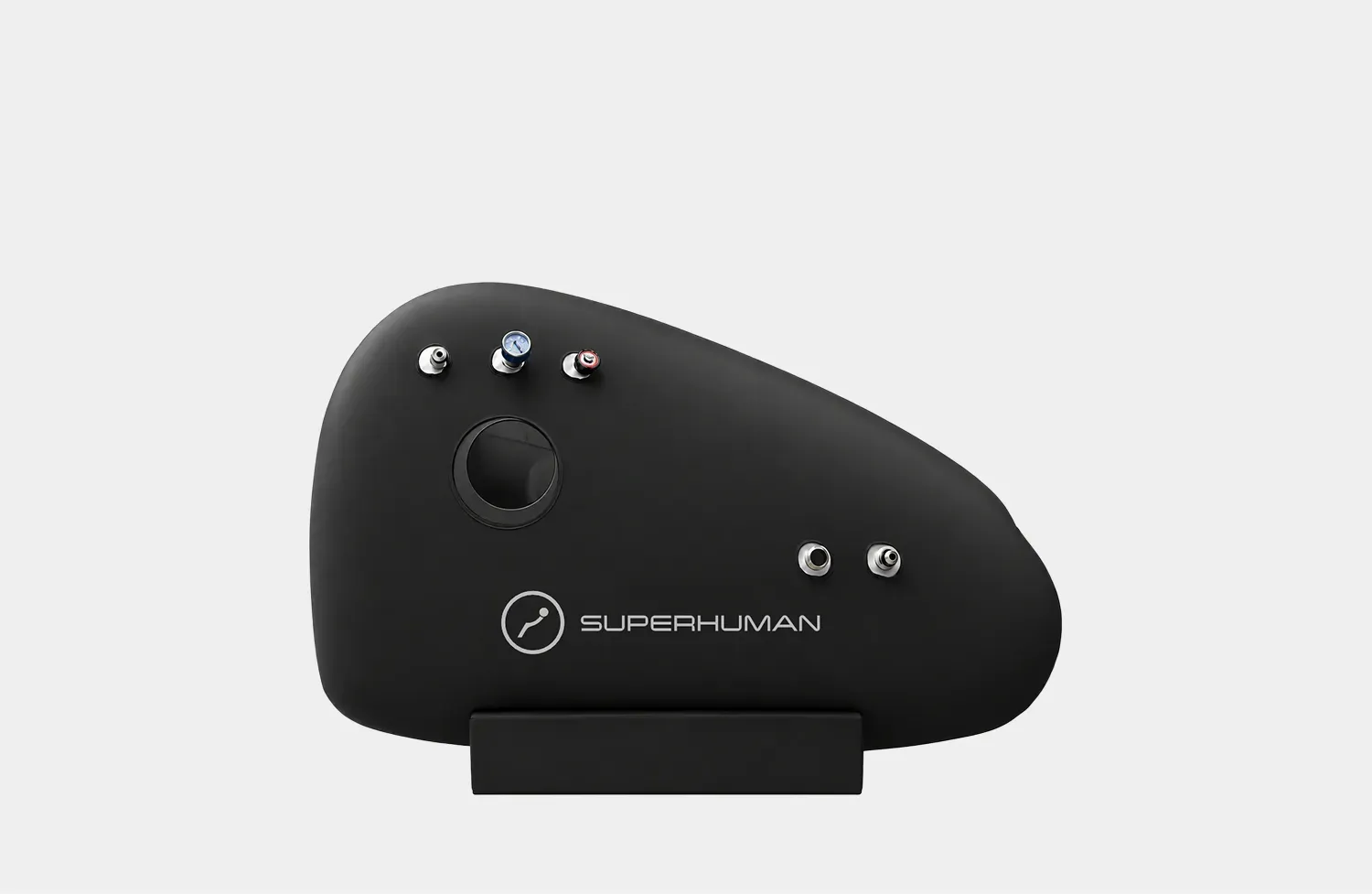
Superhuman S1, personal equipment with a three-minute routine
Superhuman S1, soft-shell $15,000 →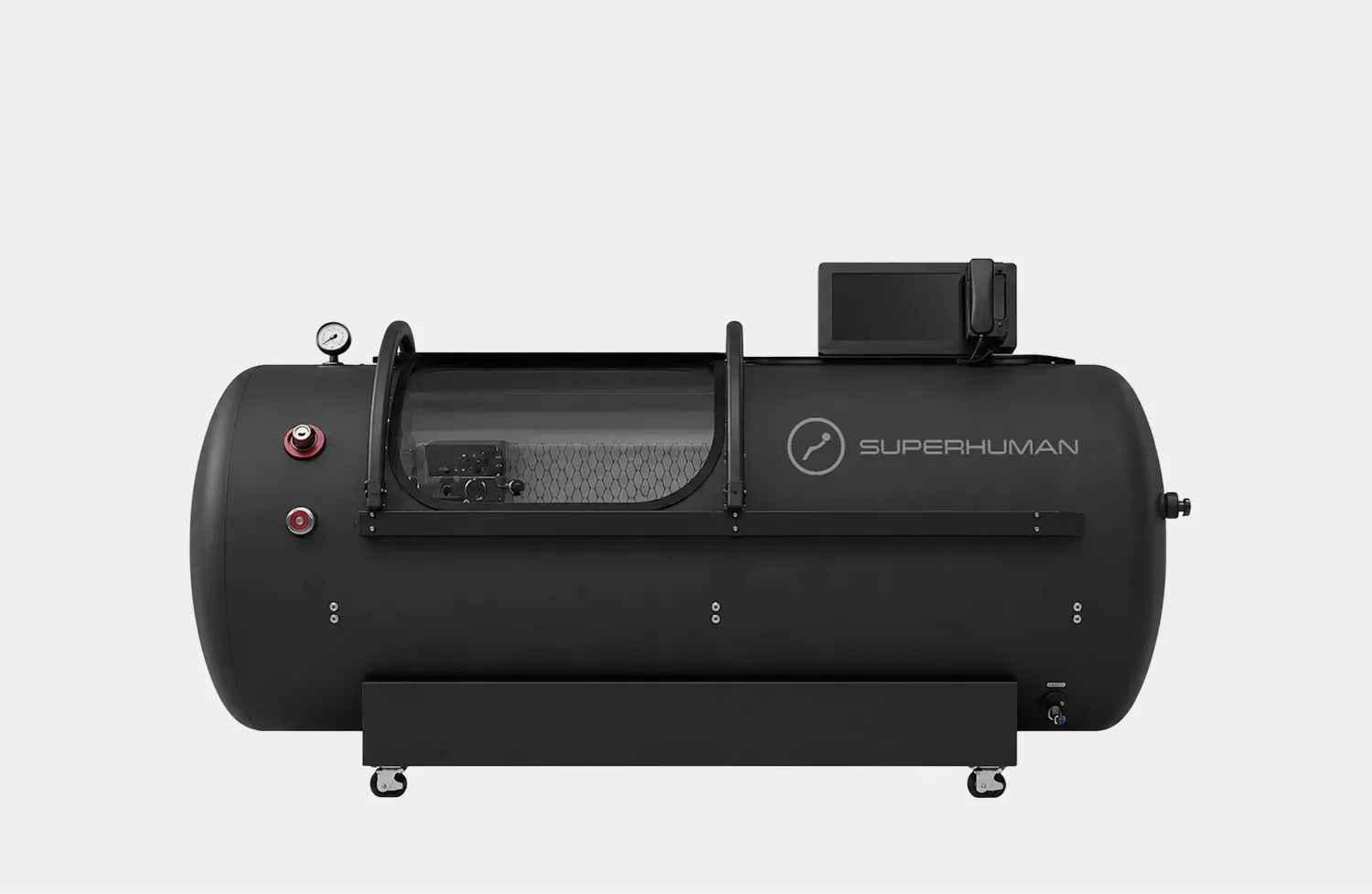
Superhuman L1, a 20 to 30 year asset on an hour-based schedule
Superhuman L1, hard-shell $49,000 →Hours, not months
Service intervals and the total-working-time counter
Aviation services engines by flight hours because calendar time tells you nothing about wear. A hyperbaric chamber deserves the same logic, so ours counts.
Every Superhuman chamber's LCD monitoring tracks oxygen concentration, pressure, and total working time. That last number is a built-in service-interval counter: instead of guessing whether "every six months" means anything for your usage, you service by the hours the machine has actually run. It matters because usage varies wildly. A home user at three hours a week and a wellness studio at forty put the same calendar year on paper and completely different years on the compressor, filters, and seals. On the Superhuman L1, that counter lives on the same LCD that shows live pressure and oxygen concentration, so a service conversation starts from a number, not a memory.
This is also a fair test to apply elsewhere. Ask any vendor how their service intervals are tracked. If the answer is a calendar and a shrug, the schedule is a guess wearing a uniform. Hour-based servicing, with the counter built into the chamber rather than bolted onto your discipline, is what a real maintenance program looks like.
The dividing line
DIY vs professional service
Most of chamber care is owner work. A short, specific list is not. Knowing which list a task belongs to is the whole skill.
Owner-safe tasks
- Interior and exterior cleaning with approved agents
- Filter inspection and replacement per the manual
- Zipper and seal cleaning and lubrication
- Visual checks: gauges at zero, hose routing, vent clearance
- Keeping the maintenance log
Technician-only tasks
- Pressure and oxygen sensor calibration
- Pressure-relief valve testing and replacement
- Compressor internal service and overhaul
- Anything electrical beyond swapping a plug
- Door alignment and gasket seating on a hard-shell
Stop conditions sit above both lists. If any of these occur, end the session, bring the chamber down normally, and contact support. No improvised repairs, ever:
- Burning smell, smoke, or sparking anywhere in the system
- A suspected oxygen leak (hissing at the concentrator or BIBS line)
- Sudden pressure change you did not command
- Venting failure or a safety-release malfunction
On the support side, here is what we can tell you about our own model: Superhuman's lifetime support means remote diagnostics, maintenance guidance, a real engineer on the support line, and replacement parts. For businesses, our white-glove installation of hard-shell chambers includes same-day operator training; S1 soft-shell owners get remote setup support. Clinical operations can go further with formal hyperbaric facility maintenance courses, and our operator licensing and certification guide maps that landscape. The chamber business guide covers the staffing side.
And because support models differ more than spec sheets admit, these are the questions worth putting to any vendor, including us:
- 01
Are your service intervals defined in working hours or calendar months?
Hours track actual wear; months are a guess. A vendor who cannot answer in hours is guessing.
- 02
Do you offer paid service plans, and what do they include?
Some vendors require a plan to keep the warranty valid. Ask before you buy, not after.
- 03
What is your response time when something breaks?
A chamber down for six weeks is an expensive ornament. Get the realistic answer.
- 04
Are replacement parts stocked and shippable?
Filters, seals, and valves are wear items. Parts availability decides whether a fix takes days or months.
- 05
Can you diagnose remotely?
Most issues are solvable on a video call if the vendor has real engineers on the line. Ours do; that is what lifetime support means in practice.
Read the exclusions
Hyperbaric chamber warranty: what the length actually means
Warranty lengths in this market run from one year to "lifetime". The number is the headline; the exclusions are the article.
Almost every warranty here covers defects in materials and workmanship, and almost none cover wear items (filters, seals, zippers) or damage from accidents, improper care, negligence, unapproved cleaners, or unauthorized repairs. Some add caps: one major brand's repair-exchange policy limits coverage to two repairs per chamber, ever. Read for the exclusions and caps first, the length second.
| Warranty tier | What it typically covers | What it typically excludes |
|---|---|---|
| 1 year, parts only | Defective parts replaced | Labor, shipping, wear items, anything after year one |
| 2 year limited | Parts and sometimes labor for defects in materials and workmanship | Wear items (filters, seals, zippers), accidental damage, unauthorized repairs |
| Component-based, 1–5 years | Different terms per component: longer on the vessel, shorter on electronics and compressors | Consumables, and whichever component has the shortest term when you actually claim |
| 10 year | Usually the pressure vessel structure | Everything that actually wears: seals, valves, electronics, labor |
| "Lifetime" | Defects in materials and workmanship, sometimes with a repair-exchange cap (one major brand caps at 2 repairs per chamber) | Accidents, improper care, negligence, normal wear and tear; read the exclusions sentence, it does the real work |
| Superhuman: 2-year warranty + lifetime support | Defects covered for 2 years; then lifetime support: remote diagnostics, maintenance guidance, a real engineer on the support line, and replacement parts | The standard exclusions (accidents, improper care, unapproved cleaners, unauthorized repairs), stated plainly rather than buried |
Our own answer is deliberately specific rather than maximally long: a 2-year warranty plus lifetime support. The warranty covers defects; the support is the part that never expires: remote diagnostics, maintenance guidance, an engineer on the line, and parts. We can commit to that because of how the chambers are built: our own ASME-certified factory, independent PVHO-1 pressure testing of every vessel, and lead engineers in California who oversee quality control and pick up the phone. Vertical control of the build is what makes lifetime support a plan rather than a promise.
Whichever chamber you are comparing, these six questions decode any warranty you are handed:
- 01
Does it cover labor, or only parts?
A parts-only warranty still leaves you paying the technician, which is often the larger bill.
- 02
Which components are classed as wear items?
Filters, seals, zippers, and gaskets wear by design. If they are excluded, the long warranty number covers very little of real ownership.
- 03
Is there a repair or exchange cap?
At least one major brand limits coverage to two repairs per chamber, ever. A cap changes what "lifetime" means.
- 04
Is the warranty transferable if I sell the chamber?
Transferability is real resale value. Many warranties die with the first owner.
- 05
Who pays shipping for a warranty repair?
Freight on a chamber-sized component is not trivial, and "we cover the part" can still leave you a large logistics bill.
- 06
What exactly voids coverage?
Typically accidents, improper care, negligence, unapproved cleaners, and unauthorized repairs. Get the list in writing before you need it.
The paperwork layer
Maintenance records, insurance, and compliance documentation
A notebook habit for home owners; a regulatory layer for businesses. Both take minutes and pay off exactly when something goes wrong.
What to log
- Date and session duration (running working hours)
- Cleaning performed and agent used
- Filter inspections and replacements
- Anything unusual: noises, smells, slow pressurization
- Service history: calibrations, valve tests, parts replaced
Why it earns its keep
The log is your evidence in a warranty claim that care was proper, the fastest way to brief a technician, and real money at resale: a chamber with a documented service history sells like a car with one.
For clinics and commercial operators, documentation stops being optional. Budget lines the market quotes: state pressure-vessel inspections at $200 to $1,000 a year where required, plus operator certification renewals every one to three years and, often, a liability insurance rider. Your authority having jurisdiction and your insurer will both want maintenance and inspection records, and the UHMS treats that documentation as part of the vessel's service life. We can supply an AHJ/insurer documentation packet for our chambers; ask for it during your consultation. The business guide covers the operating economics, and the safety guide the standards chain your inspector will reference.
Ready to compare chambers with this ownership picture in mind? Browse the full chamber lineup or book a consultation and we will walk the maintenance model for your specific usage.

FAQ
Maintenance questions
How much does it cost to maintain a hyperbaric chamber per year?
Published ranges put soft-shell upkeep at roughly $300 to $800 a year and hard-shell at $1,500 to $6,000, with the compressor the largest line item. Superhuman owners average closer to $400 a year all-in: filters run $200 to $300, the rest is a service buffer, and there are no proprietary consumables or required service fees. Electricity adds about $2 per session; a few sessions a week lands mid-range in the $15 to $60 a month figures quoted elsewhere.
How often should you clean a hyperbaric chamber?
After every session: wipe the contact surfaces with a non-abrasive, residue-free disinfectant approved for the chamber materials, and dry any condensation. Weekly, do a deeper interior clean and check filters, vents, and tubing. Monthly, inspect seals, valves, and hoses. The per-session wipe-down takes about three minutes and prevents the moisture problems that cause most odor and wear complaints.
Can you maintain a hyperbaric chamber yourself?
Most of it, yes. Cleaning, filter changes, zipper and seal care, and visual inspections are owner tasks. Calibration of pressure and oxygen sensors, pressure-relief valve testing and replacement, compressor internals, and electrical work belong to a technician. The dividing line is simple: if a task affects measured pressure, oxygen concentration, or the safety devices, it is professional work.
How long does a hyperbaric chamber last?
A soft-shell chamber typically serves 5 to 10 years with good care. A 304 stainless-steel hard-shell vessel is a 20 to 30 year asset with scheduled maintenance, which is why hard-shell service intervals and calibration history matter so much: the vessel outlasts everything bolted to it, and the maintenance record is what protects that value.
What does a hyperbaric chamber warranty cover?
Almost every warranty in this market covers defects in materials and workmanship, and almost none cover wear items like filters, seals, and zippers, or damage from accidents, improper care, or unauthorized repairs. Lengths range from 1 year parts-only to claimed "lifetime" terms, but the exclusions and caps do the real work: at least one major brand caps coverage at two repairs per chamber. Superhuman pairs a 2-year warranty with lifetime support: remote diagnostics, maintenance guidance, an engineer on the support line, and replacement parts.
What voids a hyperbaric chamber warranty?
The standard triggers are accidents, improper care, negligence, unapproved cleaning chemicals, and unauthorized repairs. The cleaner rule deserves emphasis: bleach, abrasives, and petroleum-based products can damage seals and acrylic, and using them against the manual is both a maintenance failure and a warranty problem. Keep a maintenance log; it is your evidence that care was proper if you ever need to claim.
How do you clean the inside of a hyperbaric chamber?
Use a non-abrasive, residue-free disinfectant approved for the chamber materials, wipe all contact surfaces, respect the product dwell time, and let surfaces air dry. Never use bleach unless the manufacturer specifies it, never abrasives, never petroleum-based products, and never mix cleaners. Acrylic viewports need special care per ASME PVHO-2: soft microfiber only, no ammonia, alcohol, or solvents, which craze acrylic.
Do hyperbaric chambers need professional servicing?
Yes, on an annual or working-hours cycle. A service visit covers sensor calibration, pressure-relief valve testing, a full safety inspection, and wear-part replacement. Soft-shell chambers need it least; hard-shell chambers should be on a schedule. The useful question for any vendor is how intervals are tracked: Superhuman chambers carry a total-working-time counter on the LCD, so servicing is driven by actual hours, not calendar guessing.
Last updated: August 2026. This guide is educational and does not replace the manufacturer's manual for your specific chamber. When the manual and a general guide disagree, the manual wins.