
Conditions · evidence guide
Hyperbaric Oxygen Therapy for Traumatic Brain Injury: What the Evidence Shows
Hyperbaric oxygen therapy is not FDA-cleared for traumatic brain injury, and no insurer covers it. Yet the evidence is more interesting than a simple yes or no: a mortality signal in acute severe TBI (Cochrane RR 0.69, NNT 7), null military trials in chronic mild TBI, and in 2025 the first positive double-blind trial with a true sham. Here is what the studies actually show, what a course involves, and what it costs.
The short answer
Three verdicts, one page
Search results for HBOT and brain injury blend three very different statements into one answer. Separating them is the whole story: where the evidence points, where it is still investigational, and where marketing outruns the literature.
A mortality signal: acute moderate-to-severe TBI
In the ICU, as an adjunct to standard neurocritical care, HBOT shows a mortality signal: Cochrane pooled RR 0.69 (NNT 7), and one Phase II trial reported a 26% absolute mortality reduction. But the trials are small and unblinded, and better survival with good function is unproven. This is hospital medicine, not outpatient care.
Investigational: chronic mild TBI and postconcussion symptoms
The military sham-controlled trials found HBOT no better than a low-pressure sham. A crossover trial and, in 2025, the first double-blind trial with a true near-zero-pressure sham found real symptom improvement after 40 sessions at 1.5 ATA. Net: investigational, off-label, not covered, worth an honest conversation with a physician, not a promise.
Marketing that outruns the literature
"Proven 60% mortality reduction" (the actual figure is 26% in one Phase II trial of 42 patients), "75% symptom-free after three sessions" (a conference talk, not a peer-reviewed trial), guaranteed outcomes, and before-and-after SPECT scan sales pitches. This page audits those claims against the studies they cite.
Two disclosures frame everything below, and they belong at the top, not in a footnote. First, HBOT is not FDA-cleared or approved for TBI: the agency's cleared indications cover wounds, carbon monoxide poisoning, decompression sickness, and ten other conditions, and brain injury is not among them (FDA, archived; UHMS indications). Every TBI treatment offered in the United States is off-label. Second, neither Medicare nor commercial insurers pay for it (NCD 20.29), which makes this a cash market, and cash markets attract inflated claims. A therapy can still be legitimate off-label; it just has to be discussed with the evidence, not around it. New to the therapy itself? Start with how hyperbaric oxygen therapy works.
Why oxygen became the hypothesis
One injury label, three different prognoses
"TBI" spans a concussion that resolves in two weeks and a coma that can be fatal. The HBOT evidence splits along exactly that line, which is why severity comes before mechanism on this page.
| Severity | Consciousness | Memory | What it means |
|---|---|---|---|
| Mild TBI (concussion) | Loss of consciousness under 30 minutes, or none | Memory disruption under 24 hours | 70–90% of all TBI; most recover in weeks, a minority develops persistent postconcussion symptoms |
| Moderate TBI | Loss of consciousness 30 minutes to 24 hours | Memory loss 1–7 days | Persistent cognitive, speech, fatigue, and mood problems are common |
| Severe TBI | Loss of consciousness over 24 hours, often coma | Memory loss over 7 days | ICU care, high mortality, most survivors have lasting deficits; this is where the acute HBOT trials were run |
The rationale: oxygen past the bottleneck
After a significant brain injury, the initial trauma is only the start. Swelling inside the rigid skull raises pressure, pressure restricts blood flow, and a larger zone of tissue around the original injury becomes oxygen-starved. Within that zone, neurons can survive for years in a stunned, non-functioning state that clinicians call idling: alive, but too underpowered to fire. HBOT attacks the bottleneck directly. Breathing 100% oxygen under pressure dissolves far more oxygen into blood plasma than red cells alone can carry, mild oxygen-driven vasoconstriction reduces swelling without reducing total oxygen delivery, and the resulting oxygen surplus can reach tissue the circulation cannot. That is the hypothesis, and it is mechanistically coherent. The acute severe-TBI trials exist because of it.
The chronic-stage hypothesis goes further: that repeated sessions trigger repair signaling (angiogenesis, stem-cell mobilization, reduced neuroinflammation) and can reactivate idling regions long after the injury. Functional imaging studies report exactly that pattern, and so do the marketing brochures, which is why the chronic claim needs the trial-by-trial scrutiny the next section gives it. Mechanism is a reason to run trials, not a substitute for their results.
One boundary, stated once and enforced throughout: this page covers traumatic brain injury as a whole. The deep dive on mild TBI and concussion recovery lives in our concussion evidence guide, and the related but separate story of stroke recovery and late neuroplasticity lives in the stroke research guide. Where those literatures overlap with TBI, we link rather than repeat.
The citations
The evidence, study by study
Every load-bearing claim on this page, mapped to the study behind it. The negative trials are not hidden: a page that omits them is marketing, not information.
| Study | Design & population | Protocol | What it found | Level |
|---|---|---|---|---|
| Bennett et al. 2012 (Cochrane) Cochrane Database Syst Rev | Systematic review, 7 RCTs, 571 acute TBI patients | HBOT added to standard intensive care; protocols varied (100% O2 above 1 ATA) | Mortality reduced: RR 0.69 (95% CI 0.54–0.88), NNT 7. Unfavorable outcome at 1 month: RR 0.74. Little evidence survivors had good function. Pulmonary impairment 13% vs 0% | Cochrane review |
| Rockswold et al. 2010 J Neurosurg | RCT, 3 arms, 69 severe TBI patients (mean GCS 5.8) | 60 min at 1.5 ATA, 100% O2, once daily x 3 days, started within 24 h of injury | Brain tissue oxygen rose to 223 mmHg, cerebral blood flow and metabolism improved for 6 hours, intracranial pressure fell until the next session. No oxygen toxicity detected | Mechanistic RCT |
| Rockswold et al. 2013 J Neurosurg | Phase II RCT, 42 severe TBI patients (mean GCS 5.7) | 60 min at 1.5 ATA plus 3 h normobaric 100% O2, once daily x 3 days, within 24 h of injury | Absolute 26% reduction in mortality (p=0.048) and 36% absolute improvement in favorable Glasgow Outcome Scale at 6 months (p=0.024). The strongest acute signal in the literature | Phase II RCT |
| Wolf et al. 2012 J Neurotrauma | Double-blind sham-controlled RCT, 50 service members with combat mTBI (US Air Force) | 30 sessions: 2.4 ATA 100% O2 vs 1.3 ATA room-air sham, over 8 weeks | No difference between groups on postconcussion or PTSD scores (p=0.35 and p=0.84). Both groups improved significantly over the course | Negative double-blind RCT |
| Cifu et al. 2014 J Head Trauma Rehabil | Double-blind sham-controlled RCT, 60 service members with combat mTBI (US Navy) | 40 sessions at 2.0 ATA breathing 10.5%, 75%, or 100% O2 (surface-air, 1.5 ATA, and 2.0 ATA equivalents) | No effect on postconcussion or PTSD scores at either oxygen dose versus sham compression | Negative double-blind RCT |
| Miller et al. 2015 (HOPPS) JAMA Intern Med | Randomized clinical trial at multiple US military sites, service members with persistent postconcussion symptoms | HBO2 vs sham chamber sessions | No statistically significant benefit over sham, as synthesized in the GAO-16-154 review and the VA evidence brief; one of the DoD trials behind the 2018 report to the Senate | Negative RCT |
| Boussi-Gross et al. 2013 PLoS One | Randomized crossover trial, 56 civilians with mTBI 1–5 years after injury | 40 sessions, 60 min at 1.5 ATA, 100% O2, 5 days per week | Significant cognitive and quality-of-life gains after HBOT, none after the no-treatment control period; SPECT blood-flow changes matched. Control was no treatment, not a sham, so placebo effects cannot be excluded | Positive RCT (no sham) |
| Figueroa & Wright 2016 Neurology | Review and reanalysis of the mTBI trial record | Argues pressurized-air controls (21% O2 at 1.2–1.3 ATA) are biologically active | Claims the DoD "sham-controlled" trials are really dose-comparison trials and that B-level evidence of benefit exists. Contested in published responses; a reinterpretation, not new data | Methodological critique |
| Crawford et al. 2017 J Head Trauma Rehabil | Rapid evidence assessment, 12 randomized trials through 2014 | All severities, military and civilian | Mild TBI: HBOT no better than sham in every minimal-bias study, yet both arms improved. Acute moderate-to-severe: most results favor HBOT as a relatively safe adjunct despite flawed methods. States plainly: not FDA-cleared for TBI | Systematic review |
| VA Evidence Synthesis Program 2018 VA HSR&D Management Brief 143 | Government evidence brief, 26 studies including 16 RCTs | TBI and/or PTSD | Large benefits in uncontrolled case series were not replicated in controlled trials. Evidence does not support broad use as initial treatment; a trial of HBOT may be justified only after other options fail, weighing cost and risk | Government review |
| Weaver et al. 2025 Sci Rep (Nature) | Double-blind RCT, 47 adults analyzed (40 with TBI) with persistent symptoms after brain injury | 40 sessions at 1.5 ATA, over 99% O2, 50 min at pressure, vs a true near-zero-pressure air sham; optional open second block of 40 | Symptom inventory improved 10.6 points vs 3.6 on sham (difference 7.0, 95% CI 1.7–12.3, p=0.01). The original HBOT group improved further after 80 total sessions. First positive trial with a methodologically clean sham | Positive double-blind RCT |
| Hadanny, Maroon & Efrati 2023 Med Res Arch | Literature review with guideline-style recommendations | Acute, subacute, and chronic TBI, 1969–2023 | Suggests HBOT "may be recommended" in acute moderate-severe TBI and for selected chronic patients with imaging-confirmed metabolic dysfunction. Written by a leading pro-HBOT group in a low-tier journal; a physician reviewer criticized its inclusion criteria and sham interpretation | Review (pro-HBOT authors) |
PMIDs and links for every row are in the sources card. The synthesis: the acute severe-TBI mortality signal is real but rests on small, unblinded trials; the chronic mild-TBI record was dominated by null military trials until Weaver 2025 produced the first positive result against a genuine sham. Neither bucket supports the word "proven," and both support continued research.
The sham war, explained
The central methodological fight in this field is a decade long and decides how you read every chronic-TBI trial. A proper placebo for HBOT is hard to build, because patients can feel pressure. The US Department of Defense funded a series of double-blind trials (Wolf 2012, Cifu 2014, and the HOPPS trial) that used low-pressure room air (1.2–1.3 ATA) as the sham. Result: both arms improved, neither beat the other, and the GAO's 2015 review counted six negative articles from those studies. Proponents countered, most formally in Figueroa & Wright 2016, that pressurized air is itself a treatment dose, so the trials compared two therapies rather than therapy against placebo. Skeptics, including the late Michael Bennett, the leading hyperbaric trial methodologist, doubted a mild pressure bump could be therapeutic.
Weaver 2025 is the empirical answer. The trial pressurized the sham chamber by less than 0.01 ATA, a change with no plausible biological activity, and kept every other ritual of treatment identical. Against that clean sham, 40 sessions at 1.5 ATA produced a real, statistically significant symptom benefit. One positive trial does not settle a field, and this one was small with a mixed brain-injury population. But it converts the honest verdict in chronic TBI from "probably no" to "genuinely open," and it makes the next generation of large, multicenter, true-sham trials worth running.
Where PTSD fits
TBI and PTSD travel together, especially in the military populations the DoD and VA studied, and most of the trials above measured trauma symptoms alongside postconcussion ones. The VA's 2018 evidence brief reviewed both conditions together and reached the same conclusion for each: case-series enthusiasm, controlled-trial disappointment, no support for routine use. PTSD is a separate evidence story with its own recent positive trial and its own caveats, and it gets its own page: our PTSD and mental health research guide. Nothing on this page should be read as a claim about PTSD treatment.
The protocols
What the studied courses actually look like
"HBOT for TBI" is two completely different regimens depending on the phase of the injury. Confusing them is the most common error in clinic marketing.
The chronic protocol: 40 daily sessions at 1.5 ATA
The outpatient protocol used in nearly every chronic-TBI study is a 40-session course: 60 minutes at 1.5 ATA breathing 100% oxygen, once daily, Monday through Friday, for six to eight weeks. Weaver 2025 used exactly this (50 minutes at pressure, 60 door-to-door, over 12 weeks); Boussi-Gross 2013 used it; the case literature that popularized it (Stoller 2011) used it. The Wolf and Cifu military trials varied pressure and oxygen fraction, but kept the same shape: 30 to 40 daily compressions. Weaver's open extension then introduced the unanswered dose question: patients who completed 80 total sessions improved further at 12 months, but that phase was unblinded and thinned by dropouts, so "80 beats 40" is a hypothesis, not a finding.
The acute protocol: three days inside an ICU
The severe-TBI trials were a different medicine entirely. Rockswold's teams treated patients within 24 hours of injury, once daily for just three days, at 1.5 ATA for 60 minutes (in the 2013 trial, followed by three hours of normobaric 100% oxygen), with intracranial-pressure monitors, brain-tissue oxygen probes, and microdialysis catheters in place, and ear tubes (myringotomy) for patients who could not equalize. This is adjunctive neurocritical care in a hospital, and no outpatient clinic, wellness studio, or home chamber can deliver it. When a facility quotes the acute mortality data, check which protocol they actually offer.
The cost math nobody puts on the homepage
Because TBI is not a covered indication, the market is cash-pay. Published clinic figures put a 40-session course at roughly $5,000–8,000, before travel, lodging for patients who do not live near a facility, and six to eight weeks of daily time. A second block, the Weaver dose question, doubles the money and the calendar. A physician commentator reviewing the field for MDedge in 2023 noted courses of 20–60 sessions at 90–120 minutes each, all out of pocket. The fair framing: a course of HBOT for chronic TBI symptoms is a four-figure, six-week, evidence-uncertain commitment, and anyone selling it should say so in the first conversation. How coverage works for the indications that are covered is mapped in our insurance coverage guide.
The equipment side
What the studied dose requires
Every number in the evidence table was produced by a specific class of equipment. Understanding that class matters more than any brand name, so here is the dose, then the hardware category, with zero outcome claims attached.
The chronic-TBI literature ran on hard-shell chambers pressurized with air while the patient breathes 100% oxygen through a mask or hood at 1.5 ATA, and the acute trials ran at the same 1.5 ATA inside an ICU, with full monitoring. Dissolved plasma oxygen, the proposed mechanism of the entire therapy, scales with that pressure. One physician review puts the increase at roughly 7-fold at 1.3 ATA versus 15-fold at 2.5–3.0 ATA. Soft portable chambers operate near the bottom of that range, typically fed by an oxygen concentrator rather than 100% medical oxygen, and their FDA clearance covers acute mountain sickness only. A soft-chamber session is not a cheaper version of the studied dose; it is a different dose. Our own soft-shell S1 (1.3–1.5 ATA, concentrator-fed) sits in that class, and we do not present it as the studied TBI dose. The regulatory and engineering details live in our medical-grade chambers explainer, the ATA pressure guide, and the chamber pressure levels guide, and the soft-versus-hard hardware comparison is in the soft-shell chamber guide.
For clinics and operators evaluating a neuro-adjacent program, the equipment-class takeaway is narrow and factual: the pressures the TBI trials used sit in hard-shell, medically engineered territory, with certified pressure vessels, documented oxygen delivery, and trained oversight. The single-person rung of that class in our lineup is the Superhuman L1 (2.0 ATA hard-shell, from $49,000), with the two- and four-person models shown below. Our chambers are built to that engineering class, which is the only claim we make here, and it is a claim about hardware, not about treating brain injury.
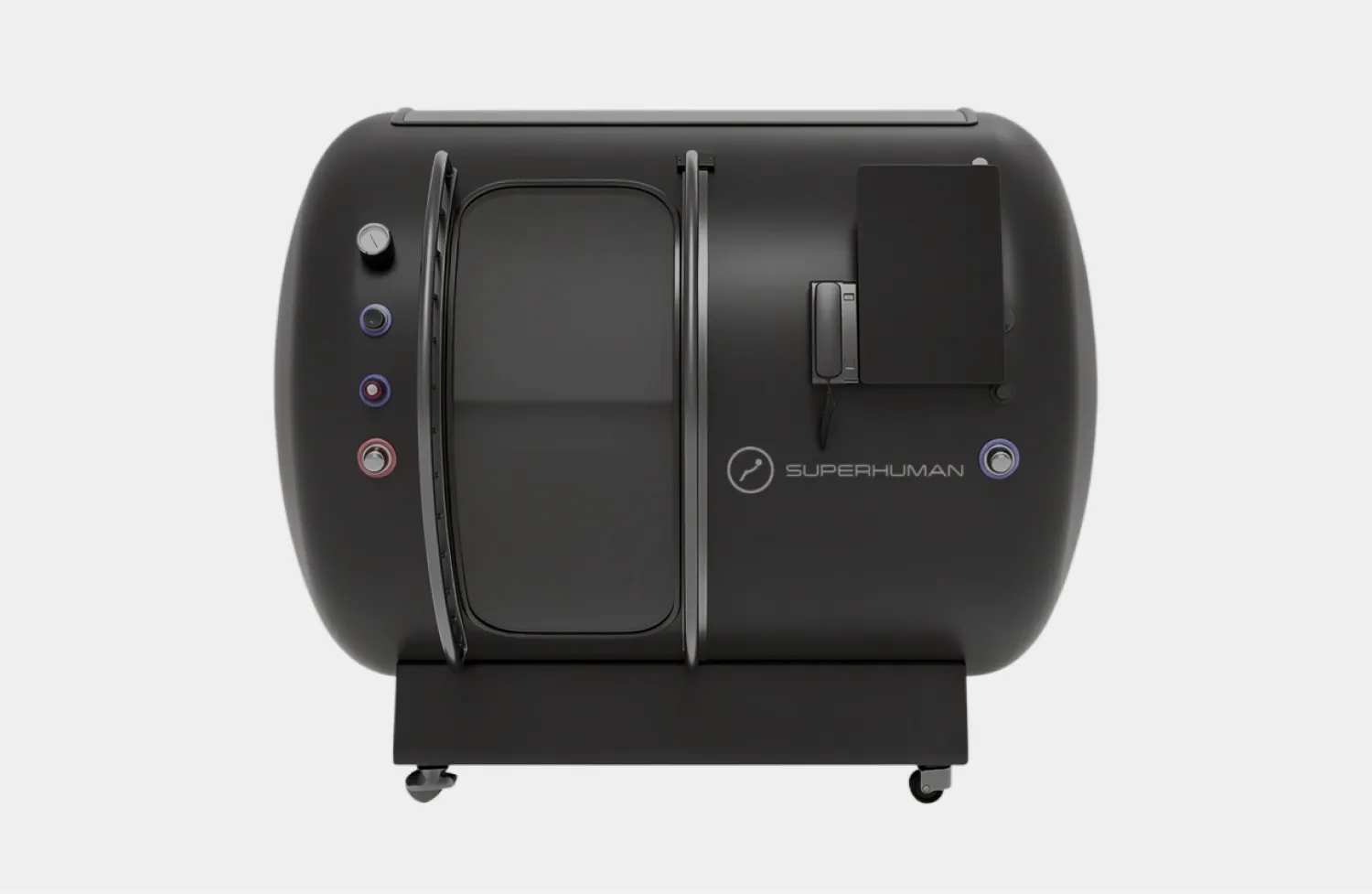
Superhuman T2: 2.0 ATA hard-shell, ASME and PVHO-1 tested, built in an ISO 13485 medical-device facility
Superhuman T2, from $125,000 →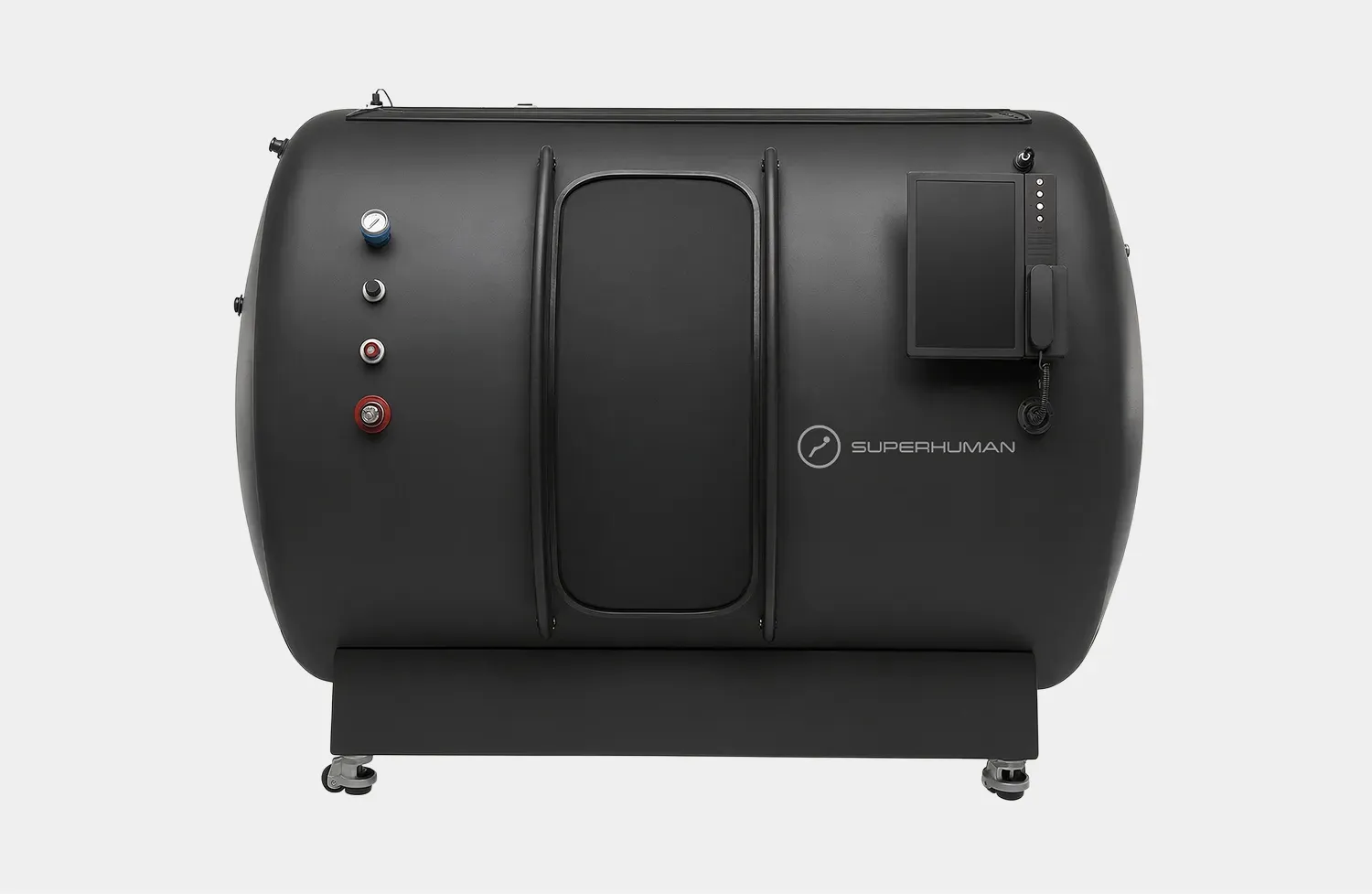
Superhuman T4: 2.0 ATA hard-shell for four occupants, ASME-certified vessel, clinical-scale throughput
Superhuman T4, from $169,000 →Scoping a chamber for a clinical or wellness operation? Book a consultation, or see the numbers in our financing and payments guide. For anything related to an actual brain injury, the path runs through a physician, not through equipment of any class.
Before the first session
Safety in TBI patients
HBOT has a real but manageable safety profile, and the TBI population carries a few specific cautions on top of the general ones.
The common side effects are mundane: ear barotrauma during compression (the reason ICU trial patients received ear tubes), sinus pain, temporary vision changes across long courses, fatigue, and claustrophobia, especially in single-person chambers. Serious events are rare in screened patients: oxygen-toxicity seizures are the one the literature tracks, and the acute severe-TBI trials that monitored for oxygen toxicity directly found none at 1.5 ATA (Rockswold 2010). The one absolute contraindication is an untreated pneumothorax. Against that, the Cochrane review recorded 13% significant pulmonary impairment versus 0% in the HBOT arms of two acute trials, a reminder that sicker patients in longer courses carry more risk (PMID 23235612).
TBI adds its own list. Post-traumatic seizures are common enough after moderate and severe injury that any history of epilepsy changes the risk-benefit math for an oxygen-toxicity event. Patients with ventriculoperitoneal shunts or other implanted hardware need a neurosurgeon's sign-off, not a technician's. Anyone unable to equalize ear pressure needs evaluation before the first dive. And the population most often offered chronic HBOT, people years into postconcussion symptoms, often has overlapping vestibular and anxiety issues that make enclosed chambers harder to tolerate. The full contraindication picture is in our chamber safety guide. The summary that matters: screened, supervised, and physician-led, or not at all.
For wellness operators
What you can say, and what you must not claim
Clients with old concussions and brain injuries will ask about your chamber. The compliant answers are short, the referral is the product, and staying inside these lines protects the client and the business.
| You can say | You must not claim | |
|---|---|---|
| Talking about TBI | HBOT is not FDA-cleared for TBI; the research is genuinely mixed and still evolving | That hyperbaric sessions treat, repair, or heal brain injury. No outcome claims, ever |
| A client with an old concussion asks | Point them to their physician and to the published evidence, including the negative trials | Selling a session package as postconcussion treatment, or quoting recovery percentages |
| Pressure honesty | State your chamber's rated pressure and that the TBI trials used 1.5 ATA with 100% oxygen under medical supervision | Citing TBI trial results as if they were produced in your studio's protocol |
| Any acute head injury | Call 911. Acute TBI is emergency medicine; the acute HBOT trials were ICU research | Any role for a wellness chamber in acute injury. None exists |
One script covers the conversation that matters most. "I had a concussion two years ago and my brain fog never left. Will this fix it?" The honest answer: nobody gets to promise that. The research in persistent symptoms is mixed, the strongest positive trial is one year old and small, and this use is not FDA-cleared or covered. What we can do is show you the studies, including the negative ones, and encourage you to bring them to your physician. An operator who says that out loud will lose some sales and keep every bit of trust, and in this market trust is the asset that compounds.
The buyer's checklist
If you are considering HBOT after TBI
Off-label does not mean off-limits; it means the burden of diligence moves to you. Here is the diligence, in checklist form.
What to ask a provider
Which protocol, exactly? Pressure in ATA, oxygen percentage and delivery (mask, hood, or chamber atmosphere), minutes at pressure, and total sessions. The studied chronic dose is 100% oxygen at 1.5 ATA for about an hour, 40 times; anything materially different is an extrapolation the provider should own out loud. What chamber class? Hard-shell with 100% medical oxygen, or a soft concentrator setup, and if the latter, which trial justifies it. Who is the physician? A named doctor who screens you, reviews contraindications, and supervises, or a waiver and a technician. What is the total cost, including the second block if the first "almost works." And the question that separates honest clinics from marketers: how do they read the negative DoD trials? A provider who knows Wolf, Cifu, and HOPPS, and can explain the sham controversy, has done the reading. One who has never heard of them has not.
Red flags, audited against the literature
"Proven to cut TBI deaths by 60%" is the field's most repeated claim, and the study behind it reported a 26% absolute mortality reduction in a Phase II trial of 42 patients (Rockswold 2013), a real but preliminary ICU finding, not a proven outpatient therapy. "75% symptom-free after three sessions" traces to a conference presentation, not a peer-reviewed trial. Before-and-after SPECT scans used as a sales tool: perfusion imaging can show change without proving the patient feels or functions better, and the strongest critic clinics make exactly this point. Guaranteed outcomes of any kind fail the basic test: the actual literature, positive studies included, reports averages across small groups, not certainties for individuals.
The route most people miss: clinical trials
Ongoing studies occasionally offer HBOT for TBI-related symptoms at no cost, inside a monitored protocol, which is simultaneously the cheapest and the most scientifically useful way to try it. Current listings are searchable on ClinicalTrials.gov. For veterans, the picture is specific: the VA does not cover community HBOT for TBI as routine care, some VA sites offer it to limited numbers of veterans case by case (VA evidence brief), and several states have passed legislation funding veteran HBOT programs, worth checking in your state before paying cash.
Honest edges
Limitations and open questions
The evidence is real where it is real and contested where it is contested. Both halves deserve the same clarity.
On the acute side, every mortality number on this page comes from trials that were small, single-center, and unblinded, and the Cochrane authors said so in plain language: HBOT may reduce the risk of death after severe TBI, but there is little evidence the survivors have good function, and routine use cannot be justified from the current record. The 26% figure that marketing inflates into 60% is one Phase II trial of 42 patients awaiting a multicenter Phase III that has never been completed.
On the chronic side, the field spent a decade arguing about whether the military trials' sham was really a sham, and Weaver 2025 answered with a clean design and a positive result. But one small, single-center trial with a mixed brain-injury population and an unblinded extension is a beginning, not a verdict. The positive chronic literature also clusters remarkably in a small number of research groups, the Weaver group's Utah program and the Efrati group's Israeli center among them, which is exactly the pattern that demands independent replication. What would settle the question is known: large, multicenter, true-sham trials with standardized outcome measures and 6-to-12-month follow-up, the same prescription the VA's reviewers wrote in 2018.
Finally, the boundary this page is built on: everything the literature tested was delivered at medical-grade pressure with 100% oxygen under physician supervision. That context is why we publish pages like this as a chamber manufacturer, and it is the same context that forbids us from promising anyone a outcome. For the indication where HBOT is established, covered, and guideline-backed, see the sibling wound healing and HBOT pillar. The contrast between the two pages is the most honest sentence we can write about this one.
FAQ
TBI and HBOT questions
Is HBOT FDA-approved for traumatic brain injury?
No. Hyperbaric chambers are FDA-cleared for 13 indications (carbon monoxide poisoning, decompression sickness, non-healing diabetic wounds, radiation injury, and others), and traumatic brain injury is not among them. Every TBI use of HBOT in the United States is off-label. The FDA has also issued a consumer bulletin warning about clinics marketing HBOT for unapproved uses. The 2017 rapid evidence assessment in the Journal of Head Trauma Rehabilitation states the regulatory position in the same terms. Any page that describes HBOT as an approved or proven TBI treatment is misstating the record.
Does insurance or Medicare cover HBOT for TBI?
No. Medicare's National Coverage Determination 20.29 covers hyperbaric oxygen therapy only for its listed indications, and TBI is not one of them; commercial insurers follow the same line. Published clinic figures put a 40-session TBI course at roughly $5,000–8,000 out of pocket, before travel and time away from work, and a second 40-session block doubles that. The VA evidence brief makes the same point to veterans: HBOT for TBI is paid for in the community, at substantial cost, without strong evidence of lasting benefit. Our insurance coverage guide, linked in the protocol and cost section above, explains how the covered indications work.
Is a soft home chamber the same treatment the trials used?
No. Every positive chronic-TBI trial used a hard chamber delivering 100% oxygen at 1.5 ATA through a mask or hood, under supervision. Soft portable chambers top out around 1.3 ATA and are typically paired with an oxygen concentrator rather than 100% medical oxygen; one physician review estimates the dissolved-oxygen increase at roughly 7-fold in that setup versus 15-fold in hard chambers at 2.5–3.0 ATA. Dissolved plasma oxygen, the proposed mechanism, scales with pressure, so a mild-pressure home session is a different dose, not a cheaper version of the same one. Soft chambers also hold FDA clearance only for acute mountain sickness.
How many sessions did the TBI studies actually use?
Two very different protocols exist. The chronic-phase studies used long outpatient courses: 30 sessions in Wolf 2012, 40 sessions in Cifu 2014, Boussi-Gross 2013, and Weaver 2025, typically 60 minutes at 1.5–2.4 ATA, five days a week, so six to eight weeks of daily attendance. Weaver 2025 then offered a second 40-session block and saw further gains, raising an unanswered 80-session dose question. The acute severe-TBI trials were the opposite: Rockswold's ICU protocol was one 60-minute session at 1.5 ATA per day for just three days, started within 24 hours of injury, inside a hospital with brain-oxygen and pressure monitoring.
Can HBOT help years after a brain injury?
That is exactly the population the chronic trials studied, and the honest answer is: maybe, in some patients, and it is not settled. Boussi-Gross 2013 reported cognitive gains one to five years after mild TBI, but its control group received no treatment, so placebo effects cannot be excluded. The DoD sham-controlled trials in similar patients were null. Weaver 2025, with the cleanest sham design to date, found a real symptom benefit after 40 sessions at 1.5 ATA. Nothing in the literature justifies a guarantee, and anyone considering a course should read our concussion recovery evidence guide, linked in the severity section above, and discuss it with a physician who knows both the positive and the negative trials.
Should I try HBOT instead of rehabilitation?
No. Even the researchers who report positive results position HBOT as an adjunct, something added to rehabilitation, not a replacement for it. The VA evidence brief concluded the evidence does not support HBOT as an initial treatment and found a trial of it defensible only after established options have been tried. For persistent postconcussion symptoms, structured rehabilitation (graded aerobic exercise, vestibular, vision, and cognitive therapy) has its own evidence base and should come first. Acute head injury is a different situation entirely: it is emergency care, and the first call is 911, not a chamber clinic.
Last updated: September 2026. This guide is educational and is not medical advice. Hyperbaric oxygen therapy is not FDA-cleared for traumatic brain injury, and any TBI use is off-label. Acute head injury is a medical emergency: call 911 first, always. Any decision about HBOT after a brain injury belongs with your treating physicians, who can weigh it against your history, your imaging, and the full trial record, positive and negative.