

Honest comparison
EWOT vs HBOT: an honest comparison of cost, pressure, and evidence
Both therapies deliver more oxygen, by different mechanisms: EWOT raises oxygen flow through exercise, HBOT raises dissolved plasma oxygen through pressure, about 2 vol% versus 4.6 vol%. Verdict: EWOT is a fitness tool; HBOT is medical-grade therapy. Here are the numbers.
Definitions first
What EWOT and HBOT actually are
EWOT is fifteen active minutes on a bike breathing concentrated oxygen. HBOT is sixty to ninety passive minutes resting in a pressurized chamber. Both move more oxygen into you; how they do it is the entire difference.
EWOT at a glance
Exercise with oxygen therapy: 15 active minutes on a bike, treadmill, or rower while breathing oxygen-enriched air (FiO2 about 93%) through a mask fed by a concentrator and reservoir bag. One atmosphere of pressure, no prescription, home systems run $1,900 to 2,500.
HBOT at a glance
Hyperbaric oxygen therapy: 60 to 90 passive minutes resting in a sealed chamber pressurized to 1.3 ATA (soft-shell) or 2.0 ATA and above (hard-shell), breathing close to 100% oxygen. FDA Class II medical device; clinical sessions run $250 to 750.
EWOT (exercise with oxygen therapy) pairs a workout with an oxygen supply. You pedal, walk, or row at a genuine training intensity, typically 70 to 80% of maximum heart rate, while a mask feeds you oxygen-enriched air at an FiO2 of about 93% from a concentrator and a reservoir bag. The whole session runs about 15 minutes, the equipment costs $1,900 to 2,500, and it lives in a spare room with no prescription and no supervision.
HBOT (hyperbaric oxygen therapy) removes the exercise and adds pressure. You lie or sit inside a sealed vessel pressurized above normal atmospheric pressure, measured in ATA: 1.3 to 1.5 ATA in a soft-shell chamber, 2.0 ATA and above in a hard-shell, breathing close to 100% oxygen for 60 to 90 minutes. You read, work, or sleep. Hyperbaric chambers are FDA Class II medical devices, and the therapy is delivered clinically for a defined list of indications.
The active-versus-passive split is the mechanism split: EWOT's effects ride on the exercise, HBOT's ride on the pressure. Every section that follows is a consequence of that one fact.
The numbers nobody publishes
The real difference: circulation vs pressure
Henry's law decides this comparison: oxygen dissolves into blood plasma in proportion to pressure, and EWOT never leaves normal pressure. The ceiling that creates is visible in four rows of numbers.
EWOT works on throughput. Hard exercise pushes ventilation toward 100 liters per minute and cardiac output to several times its resting value, so a much larger volume of oxygen-rich blood reaches working muscle per minute. That is a real effect, and it is why EWOT feels like a strong training session. But the oxygen still rides almost entirely on hemoglobin, and the arterial partial pressure is capped by physics at normal atmospheric pressure.
HBOT works on content. By Henry's law, oxygen dissolves into blood plasma in direct proportion to its partial pressure (0.0031 mL O2 per dL per mmHg). Pressurize the chamber and the plasma itself becomes an oxygen carrier, independent of hemoglobin and independent of how well a tissue is perfused. The classic physiology references and the New England Journal of Medicine review (PMID 8628361) put numbers on it, and they are large:
| Condition | Pressure | FiO2 | Arterial PaO2 | Dissolved plasma O2 |
|---|---|---|---|---|
| Breathing room air at rest | 1.0 ATA | 21% | ~100 mmHg | ~0.3 vol% |
| EWOT ceiling: oxygen + exercise, normal pressure | 1.0 ATA | ~93% | ~500 to 600 mmHg | ~2 vol% (about 6×) |
| Soft-shell chamber (mild HBOT) | 1.3 ATA | ~90 to 100% by mask | ~800 to 900 mmHg | ~2.6 to 2.9 vol% (about 9×) |
| Hard-shell chamber | 2.0 ATA | 100% | 1,400 to 2,000+ mmHg | ~4.6 vol% (about 14×) |
Values via Henry's law and the alveolar gas equation; physiology references PMIDs 8628361, 21131185, 5305672, linked from the sources card. Ranges reflect normal individual variation.
Read the last column twice, because it is the whole comparison. At 2.0 ATA the plasma alone carries about 4.6 vol% of dissolved oxygen, enough to approach what resting tissue normally extracts from hemoglobin entirely. That is why HBOT can oxygenate tissue with compromised circulation, and why pressure, not exercise, is the variable that matters medically. Exercise cannot cross the normobaric ceiling: at 1.0 ATA, PaO2 stops near 500 to 600 mmHg no matter how hard you pedal. For what those pressure tiers mean in practice, see what ATA pressure means in a hyperbaric chamber and the pressure levels guide.
The viral claim, checked
Is 15 minutes of EWOT really equal to 90 minutes of HBOT?
No. The claim survives on a metric swap: it is roughly true for liters of oxygen inhaled and false for the variable HBOT is built on, dissolved plasma oxygen.
The equivalence claim originates in EWOT vendor marketing and has spread across most of the search results for this topic. The arithmetic behind it is real, and it is worth stating fairly: exercising hard at about 100 liters per minute of ventilation on 93% oxygen for 15 minutes moves on the order of 1,370 liters of oxygen through the lungs. Set against a modeled resting HBOT session, that is a comparable volume of oxygen processed. If the metric is inhaled liters, the claim holds.
The problem is that inhaled liters are not the therapeutic variable. What makes HBOT a medical treatment is the partial pressure of oxygen dissolved in plasma, and on that metric the two sessions are not in the same category: about 2 vol% versus 4.6 vol%, per the table above. Fifteen minutes of EWOT and ninety minutes of HBOT process similar oxygen volume and produce dissimilar tissue oxygen tension. Both halves of that sentence are true; quoting only the first is the swap.
Two honest footnotes. First, no direct EWOT-versus-HBOT head-to-head study exists; anyone asserting equivalence is doing arithmetic, not citing evidence. Second, if your goal is fitness, you do not need the equivalence to be true, because EWOT's training value stands on its own. If your goal is medical, the equivalence is not true.
What research actually exists
The evidence base, side by side
EWOT's direct research is thin and old; its credible evidence is borrowed from COPD rehabilitation studies that are not, strictly, EWOT. HBOT carries decades of randomized trials, FDA Class II clearance, and 14 UHMS-recognized indications.
The branded EWOT literature
EWOT descends from Manfred von Ardenne's "oxygen multistep therapy," developed in Germany from the 1970s onward. That literature is mostly German-language, from the 1970s to 1990s, with small samples and largely uncontrolled designs. The strongest single item is a double-blind RCT of 20 healthy men that found an endurance improvement two weeks after two 15-minute sessions (PMID 6711017). Vendor claims of "10,000 studies" trace to the bibliography of von Ardenne's book, not to EWOT trials.
The adjacent literature EWOT borrows
The credible evidence for exercising with extra oxygen lives under a different name: supplemental oxygen during exercise training, a real and moderately sized randomized literature concentrated in COPD and pulmonary rehabilitation. A meta-analysis of 51 studies (PMID 28975517) on hyperoxia and exercise performance anchors it, with measurable effects on acute exercise capacity, endurance time, and breathlessness. Two honest caveats: these trials deliver oxygen by mask at normal pressure, which is neither branded EWOT nor hyperbaric, and several RCTs found no added training benefit versus air for long-term adaptation. The evidence supports the workout, not the medical claims.
The HBOT literature
HBOT's evidence base is of a different order: decades of randomized trials and large case series behind its cleared indications, including a 1,144-patient series in diabetic foot ulcers (PMID 12191001). The regulatory layer matches: chambers are FDA Class II medical devices, the UHMS recognizes 14 indications, and Medicare reimburses them under NCD 20.29. The full list is in our guide to FDA-cleared HBOT indications.
Symmetrical honesty applies here too. HBOT has its own halo of unproven uses, and the FDA warns consumers directly about claims beyond the cleared list. "Cleared device" means cleared for named indications, not for everything a clinic can think of.
The money question
Cost and ownership: the five-year math
EWOT costs about $2,000 once. A clinical HBOT course costs $10,000 to 30,000 and ends. A home chamber costs $15,000 and up and stays. Five years in, the paths look like this.
| Path | Upfront | Five-year cost | What you hold in year five |
|---|---|---|---|
| EWOT system (concentrator, reservoir, mask) | $1,900 to 2,500 | about $2,000 to 2,800 (mask and filter replacements) | The equipment and unlimited 15-minute sessions |
| Home soft-shell chamber (Superhuman S1, 1.3 to 1.5 ATA) | from $15,000 | about $20,000 at daily use | The chamber and unlimited sessions; cost per session keeps falling |
| Home hard-shell chamber (L1 class, 2.0 ATA) | from $49,900 | about $54,000 at daily use | Clinical-level pressure at home, on your schedule |
| Clinical HBOT course | $0 | $10,000 to 30,000 per 40-session course at $250 to 750 per session | Nothing; a second course doubles the spend |
The break-even logic is straightforward. Against clinical pricing, a home chamber pays for itself within roughly one to two 40-session courses for a frequent user; our hyperbaric chamber cost guide carries the full market pricing and running-cost detail, and the cost calculator runs your own session frequency through the same math. EWOT's break-even is measured in weeks, which is exactly the point of the "choose EWOT" section below: if it covers your goal, it is the rational buy by an order of magnitude.
The insurance asymmetry belongs in any honest cost comparison. Clinical HBOT for FDA-cleared, UHMS-recognized indications is reimbursable, which can change the clinical-course row from $10,000 to 30,000 out of pocket to a copay. EWOT is never reimbursed. The mechanics are in our insurance coverage guide.
Both sides, honestly
Safety and contraindications on both sides
Neither therapy is risk-free. HBOT's risks come from pressure; EWOT's come from exertion. "EWOT has no risks" is marketing, not physiology.
HBOT: the pressure risks
The most common side effect is mundane: ear barotrauma during compression, usually preventable with equalization. Temporary changes in visual acuity can appear across a long course, and oxygen toxicity is a real but rare, protocol-managed risk at clinical pressures. The one absolute contraindication is an untreated pneumothorax, with relative cautions around certain lung conditions, recent ear surgery, some chemotherapy agents, and severe claustrophobia. The full picture lives in our hyperbaric chamber safety guide and the side effects and contraindications guide; this page deliberately does not duplicate them.
EWOT: the exertion risks
EWOT involves no pressure, so barotrauma is off the table, and at 15 minutes of normobaric oxygen there is no meaningful oxygen-toxicity exposure. What remains is the risk profile of vigorous exercise itself: sessions run at 70 to 80% of maximum heart rate, which means cardiovascular screening matters for anyone with known or suspected heart or lung disease, and falls, overexertion, and lightheadedness are ordinary gym-category risks. The structural contraindication is the simplest one: if you cannot exercise safely, you cannot do EWOT, which is precisely the population HBOT often serves. Talk to a physician before starting either therapy if you have any cardiovascular or pulmonary history.
The anti-oversell
Choose EWOT if you are healthy and your goal is fitness
A straight answer from a chamber manufacturer: if you are healthy, can train hard for 15 minutes, and your goals are energy and performance, buy the $2,000 EWOT system. You do not need our chamber.
EWOT is the right purchase when all of these are true: you have no diagnosed condition on the FDA or UHMS indication list; you can sustain 15 minutes at 70 to 80% of maximum heart rate; your goals are endurance, workout performance, energy, and general wellness; your budget is under $3,000; and a short daily habit fits your life better than a 90-minute one. For that buyer, a $2,000 concentrator-and-mask setup is the rational choice by every metric on this page: cost, time, and the evidence that actually exists for exercising with oxygen.
This is not a consolation prize. EWOT is a legitimate training tool with a real, if adjacent, evidence base, and the convenience is genuine: 15 minutes, no prescription, no appointments. Where it stops is equally clear: it cannot treat a medical condition, and no session length lets it reproduce the pressure-driven plasma loading in the physics table. If your situation sits on the medical side of that line, read the next section instead.
When pressure is the point
Choose HBOT if the requirement is medical
HBOT earns its price when the job is one exercise cannot do: a cleared indication, tissue that needs oxygen circulation alone cannot deliver, or a body that cannot train.
The HBOT-side criteria: a diagnosed condition on the FDA-cleared, UHMS-recognized indication list; a physician who recommends the therapy; an inability to exercise safely; or a goal that requires raised tissue oxygen tension, such as recovery around surgery or support for poorly perfused tissue. The full capability picture is in our hyperbaric chamber benefits guide, and the case for daily home access in the home hyperbaric chamber guide.
| Criterion | Choose EWOT if | Choose HBOT if |
|---|---|---|
| Diagnosed condition on the FDA / UHMS cleared list | No | Yes |
| Able to exercise 15 minutes at 70 to 80% of max heart rate | Required | Not required |
| Need oxygen delivered to poorly perfused tissue (raised tissue pO2) | No | Yes |
| Primary goal | Fitness, energy, endurance | Recovery, medical support |
| Budget | Under $3,000 | $15,000+ home, or per-session clinical |
| Session format you will keep | 15 minutes, active | 60 to 90 minutes, passive |
| Regulation and insurance | Wellness equipment, never reimbursed | FDA Class II device; reimbursable for cleared indications in medical facilities |
If a chamber is the answer
Two models, two pressure tiers
This page compared pressure tiers, not brands. If the decision table points you to HBOT at home, these are the two Superhuman models that match the two chamber tiers above.
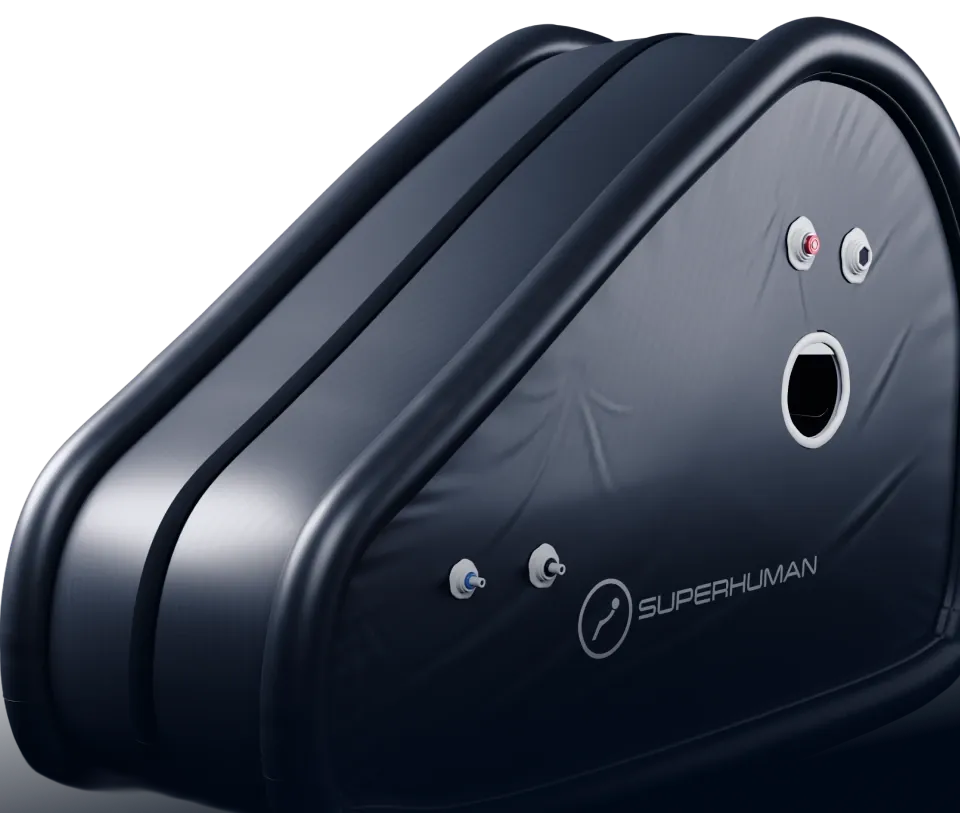 Lying-Down Hard-Shell Superhuman L1 The 2.0 ATA tier: clinical-level pressure at home, lying down. Pressure Up to 2.0 ATA Capacity 1 person Format Lying down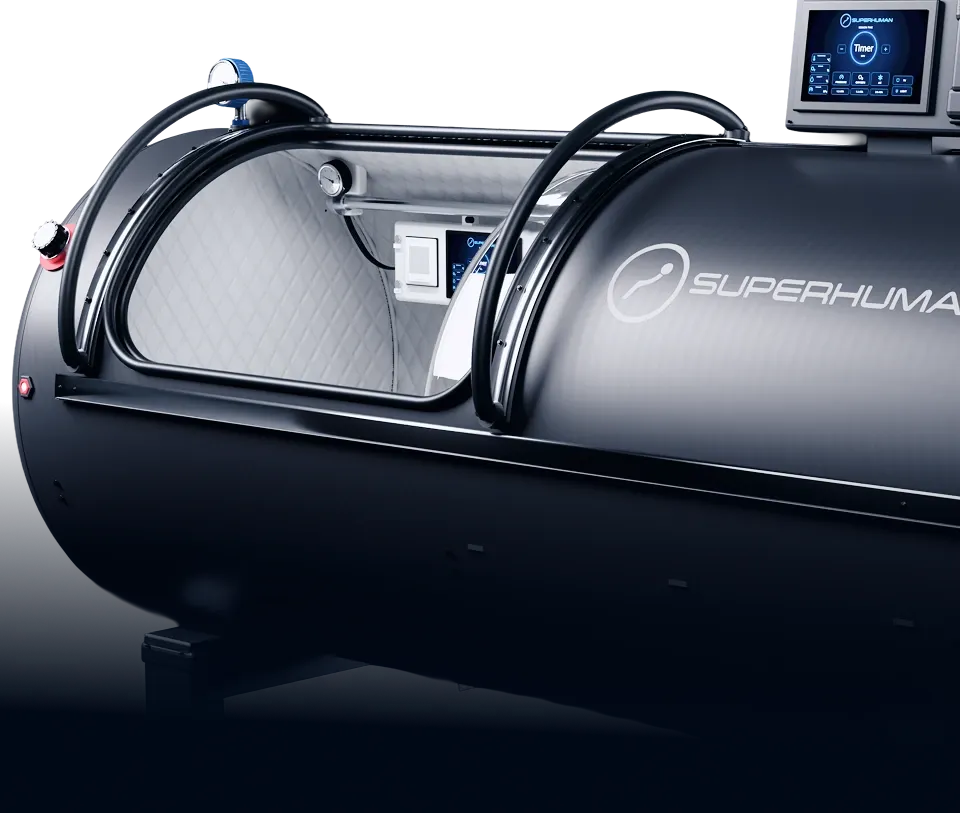
Compare all models side by side on the chambers for sale page, from $15,000 to $169,000.
The stack
Can you use both? Yes, and they stack cleanly
EWOT is the training stimulus; HBOT is the recovery and medical layer. They do not compete, because they do different things.
Owners who run both treat them as complements on a weekly schedule. A typical pattern: EWOT on training days, 15 minutes inside or immediately around the workout, and HBOT on recovery days, 60 to 90 minutes of pressure-driven plasma loading while you rest, read, or work. The logic mirrors the physics: exercise days call for throughput, recovery days call for content.
Two boundaries keep the stack honest. If HBOT is being used for a cleared medical indication, the physician's course governs the schedule, and EWOT waits for medical clearance like any other exercise. And neither therapy fills in for the other: EWOT does not replace missed chamber time on a medical protocol, and HBOT is not a workout.
FAQ
EWOT vs HBOT questions
Is EWOT as good as HBOT?
They are different tools, and the honest answer depends on the goal. For fitness, energy, and endurance goals in healthy people who can exercise hard for 15 minutes, EWOT delivers real training value for about $2,000. It cannot match HBOT on the medical variable: dissolved plasma oxygen tops out near 2 vol% at normal pressure versus about 4.6 vol% at 2.0 ATA, and EWOT has no FDA-cleared medical indications. No head-to-head EWOT versus HBOT trial exists, so any equivalence claim is arithmetic, not evidence.
Why not just breathe oxygen at rest without exercise?
Because rest removes the one mechanism EWOT has. Breathing 93% oxygen while sitting still raises arterial PaO2 to the same 500 to 600 mmHg ceiling, but resting ventilation is only about 6 to 10 liters per minute against 100 liters per minute in hard exercise, and cardiac output stays low, so far less oxygen reaches working muscle. Without the exercise you keep neither EWOT's circulation-driven throughput nor HBOT's pressure-driven plasma loading. Resting oxygen breathing is the weakest option of the three.
Is EWOT safe?
For healthy, screened users, generally yes: there is no pressure, so there is no barotrauma risk. The real risks are those of vigorous exercise itself: cardiovascular events in unscreened users, falls, overexertion, and lightheadedness. Anyone with a heart or lung condition should get physician clearance first, and anyone who cannot exercise safely should not do EWOT at all. Vendor claims that EWOT has no risks whatsoever are marketing, not physiology.
How much does an EWOT system cost?
A complete home EWOT setup, an oxygen concentrator, a reservoir bag, and an exercise mask, runs $1,900 to 2,500, with only minor mask and filter replacements after that. There are no per-session fees once you own it, and no insurance coverage, since EWOT is classed as fitness equipment rather than a medical device. Where clinics offer supervised EWOT, sessions are typically priced like personal training.
Is a soft-shell home hyperbaric chamber worth it?
It depends on the job. A soft-shell chamber at 1.3 to 1.5 ATA (our S1, $15,000) sits between EWOT and clinical HBOT: it produces genuine pressure-driven plasma loading, about 2.6 to 2.9 vol% dissolved oxygen versus about 2 for EWOT, with unlimited daily sessions at home, but below the 2.0 ATA used in most studied medical protocols. For wellness and recovery routines it can be the right tool; for cleared medical indications, treatment belongs in a medical facility. The pressure-levels guide linked on this page walks the tiers in detail.
Does insurance cover HBOT or EWOT?
HBOT, yes, when it is delivered in a medical facility for an FDA-cleared, UHMS-recognized indication: Medicare covers those indications under National Coverage Determination 20.29, and most commercial policies follow. Wellness and home use is not reimbursed. EWOT is never covered: it is fitness equipment with no cleared indications. The full mechanics of authorization, session caps, and documentation are in our insurance coverage guide.
Do you need a prescription for EWOT or HBOT?
EWOT, no: it is exercise equipment sold directly to consumers. Hyperbaric chambers are FDA Class II medical devices, and clinical HBOT for cleared indications is delivered by physician order in accredited facilities. For home chamber use, involve your physician in the decision and read our chamber safety guide first; certain ear, lung, and other conditions are contraindications regardless of where the chamber sits.
Last updated: August 2026. This comparison is educational and is not medical advice. It summarizes published research and regulatory positions, which evolve. Decisions about hyperbaric oxygen therapy, and about exercising with oxygen alongside any medical condition, belong with your physician. We make no disease claims.