


01
You step in.
Take a seat or lie flat: a zero-gravity recliner or a memory-foam bed, depending on the model.
Now accepting HSA/FSA on eligible orders
Learn more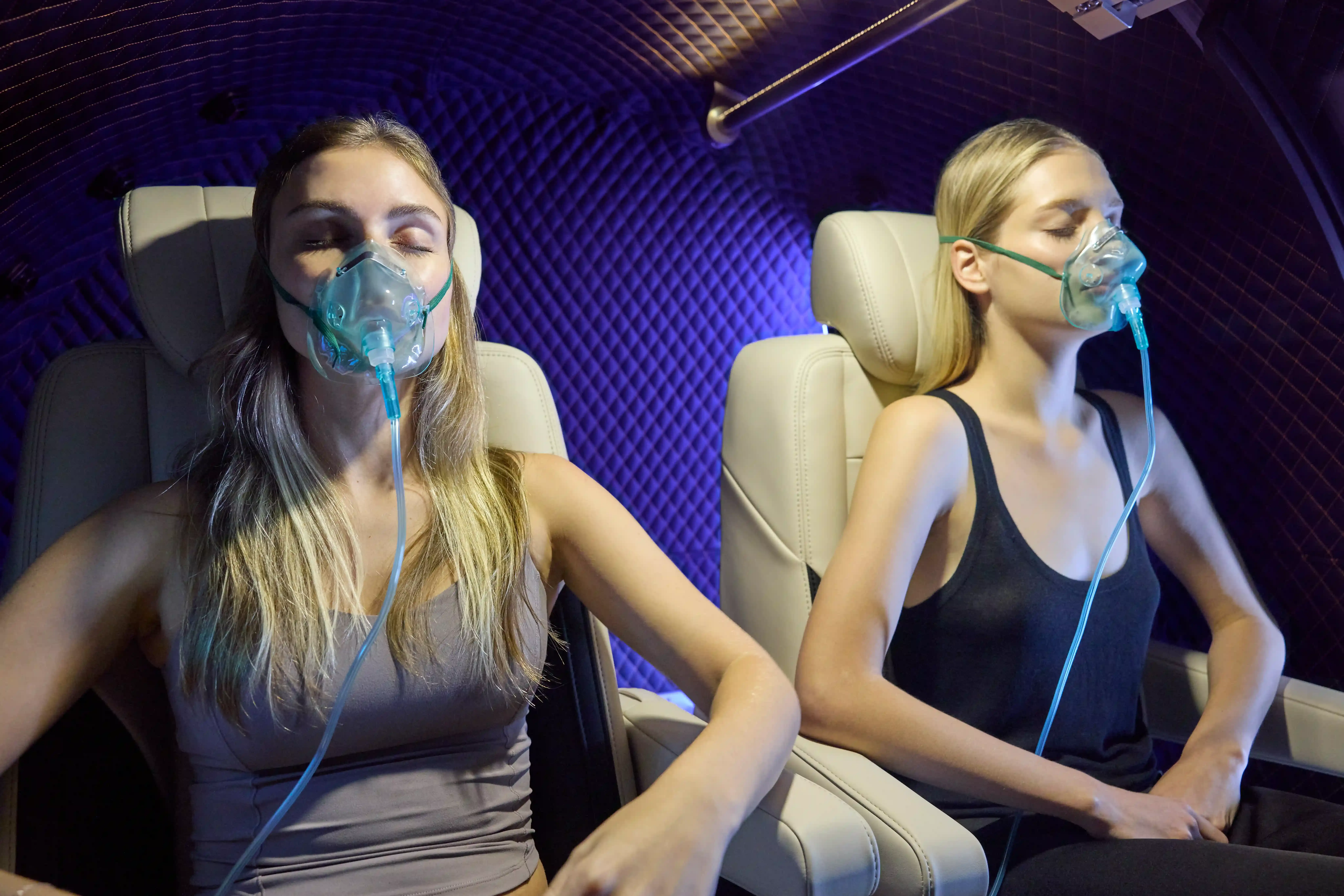
A session, minute by minute: the pressure, the oxygen, what you feel. We explain the mechanism. Whether it's right for you is your clinician's call.
Hyperbaric oxygen therapy
A sealed chamber, higher pressure, oxygen through a mask. No needles, nothing invasive.
The door closes and the pressure inside goes up, to somewhere between 1.3 and 2.0 times normal.
You put on a mask and breathe oxygen. When the session's over the pressure comes back down and the door opens.
That's all it is.


Hyperoxia
Air already fills your red blood cells, so breathing more oxygen on its own changes little. Pressure is what changes it.
Under pressure, oxygen dissolves straight into your plasma, the way a sealed soda can holds more carbon dioxide than an open one.
That's hyperoxia: more oxygen in the blood than air can deliver.

The sequence
Same steps, always in the same order. Nothing changes between your first session and your fiftieth, or between one chamber and the next.
01
Take a seat or lie flat: a zero-gravity recliner or a memory-foam bed, depending on the model.

02
Oxygen comes only through the mask, so it goes on first. The cabin itself is pressurized with air.

03
Pressure builds over the first few minutes. Your ears feel it like on a plane. Swallow and they clear.

04
The chamber holds depth for 60 minutes. Nothing to adjust. Read, sleep, or just breathe.

05
Pressure eases back over a few minutes. Your ears clear the other way, the door opens, and you step out.
What happens inside
Your blood can only carry so much oxygen the normal way. Pressure gives it a second way in, and that oxygen reaches all of you.


Your brain is about 2% of your weight and uses around 20% of your oxygen. Dissolved oxygen reaches it the same way it reaches everything else.
Oxygen still enters through the lungs, breath by breath. Under pressure, more of it crosses from each breath into the blood, and the plasma carries the extra onward.
On ordinary air, red blood cells are already close to full. Pressure pushes extra oxygen into the plasma, the liquid part of the blood, which needs no carrier to move it.
Muscle draws oxygen from the blood passing through it. Oxygen carried in the plasma arrives by the same route, alongside what the red blood cells deliver.
The finest vessels are narrower than a red blood cell. Oxygen dissolved in plasma travels wherever the plasma travels, and that includes these.
Past the bottleneck
Dissolved oxygen travels further from the capillary than oxygen bound to red cells.
Cellular energy
Under pressure, oxygen dissolves into plasma, not just red blood cells.
Less inflammation
HBOT suppresses TLR4 and NF-κB signalling, the pathway that drives inflammatory cytokine release.
Stem cells into circulation
One session doubled circulating stem and progenitor cells. Twenty sessions raised them eightfold.
Deeper sleep
In a randomised trial, participants reported better sleep quality after a course of sessions.
Cellular aging markers
In a trial with no control group, telomere length in blood cells rose and senescent cells fell after 60 sessions.
Antioxidant defences
The brief oxidative signal is what switches on the body's own antioxidant enzymes.
Nervous system tone
Heart rate variability rose after a single session, the pattern associated with parasympathetic activity.
Neuroplasticity
Imaging in treated patients showed changes in brain microstructure alongside new vessel growth.
Bone and connective tissue
Animal studies show higher bone mineral density and more collagen in healing tendon.
Focus and processing speed
In a controlled trial in healthy older adults, attention and processing speed improved alongside measured increases in blood flow to the brain.
Blood sugar response
In a blinded crossover trial in men with type 2 diabetes, one session lowered fasting glucose by 19 percent.
New capillaries
Repeated sessions trigger VEGF and the growth of new blood vessels into tissue.
Skin and collagen
Biopsies after 60 sessions showed higher collagen density and more dermal blood vessels.
Recovery and repair
A 2025 meta-analysis found faster recovery from exercise-induced muscle damage. Soreness itself did not change.
Senescent cells
Skin biopsies after a course of sessions showed fewer senescent cells, a first in human research.
Mitochondrial capacity
A blinded crossover trial measured improved mitochondrial capacity after a single session.
Easier flow
Red cells become more deformable and blood thins slightly, so it reaches narrower vessels.
Immune cell behaviour
One session primes white blood cells. A course of sessions damps them down instead.
Third party
Nobody on this slider works with us. They talk about pressure and oxygen on their own channels, and we quote them with the source.
60 sessions. One verdict.
“HBOT is the most effective longevity therapy I’ve done.”
Bryan Johnson Founder, Blueprint and Don’t Die

Two hours a session. Beijing 2022.
“Anytime I went, I noticed my resting heart rate would come down, and any swelling I was experiencing would come down, too.”
Nina O’Brien U.S. Olympic alpine ski racer

Eight Olympias. One chamber.
“Without the Hyperbaric treatment my pain progression takes 4 days for the pain to cease… With the Hyperbaric treatment the pain progression stops in 1 day… But most important I feel great.”
Ronnie Coleman 8× Mr. Olympia

40 sessions. Two to three a week.
“Hyperbaric chambers is the best, man. It’s incredible.”
Mel Gibson Actor and director

Support
Your ears feel the pressure change, the way they do when a plane climbs or descends. Swallowing or yawning clears them, and the pressure changes slowly on purpose.
Say so on the intercom and whoever’s running it brings the pressure down. Every hard-shell also carries a depressurization control inside, within reach of the seat.
Most run about 60 minutes at pressure, plus a few minutes up and down. The chambers allow 30 to 120, and your clinician sets the protocol.
In the T2, yes: two seats. The T4 seats four. The X, L1 and S1 are single-person.
We go through what can and can’t go inside on the walkthrough, before your first session.
Anyone you choose. We show them the controls before the first session, and a real person stays on call.
Ask your clinician before you buy. That’s a medical question, and the answer depends on the person, not the chamber.
See Safety & Standards: every standard, what it governs, and the document you can request.
That’s a question for your clinician.
The lineup
Five of them, from a soft-shell that folds away to a walk-in for four. The room decides more than the budget does.
Seated
You sit up, read or work, at 2.0 ATA, in the least floor space of the two hard-shells.
From $110,000
Explore X
Two seats
Walk-in, 1.5 or 2.0 ATA, two people at once. Two chairs, a bed, a lounge or an L-shaped bench: the layout is yours to set.
From $125,000
Explore T2
Four seats
Walk-in, 1.5 or 2.0 ATA. Same cabin height and width as the T2, with more length for four seats or bench layouts.
From $169,000
Explore T4
Lie-flat
Flat for the whole session, at 2.0 ATA, and quiet enough to share a wall with a bedroom.
From $49,000
Explore L1
Portable soft-shell
Single-person, folds down, no permanent installation.
From $15,000
Explore S1
First step
Give us the date and we’ll work back from it. Delivery, install and the staff walkthrough all have to happen before your first booking. Hard-shells typically take 3 to 5 weeks from order.
Or just contact William directly.

All-inclusive pricing
Elsewhere, getting a hard-shell chamber running means a stack of separate invoices. Here, it’s already in the price on the card.
No broker fee · no freight · no setup bill · no second invoice.
All-inclusive pricing
The S1 arrives ready to set up in minutes, with no install crew to pay for. The price covers everything around it.
No broker fee · no freight · no setup bill.
