
The short answer: Most hyperbaric chamber sessions last 60–90 minutes of time at pressure, plus about 10–15 minutes each for pressurizing and depressurizing, so plan on 90–120 minutes door to door. Clinical protocols typically run five days a week; most home and wellness users do three to five sessions per week.
Disclosure: Superhuman Chambers manufactures and sells hyperbaric chambers for wellness operators. This article summarizes published research and clinical guidance for education only and is not medical advice.
How long is a hyperbaric chamber session?
Session length depends on the setting. Clinical hyperbaric oxygen therapy runs longest: Cleveland Clinic puts typical sessions at one to two hours, and Mayo Clinic narrows it to 1.5 to 2 hours for most conditions. Wellness and home sessions are shorter, typically 60–90 minutes at pressure. Every session also includes time to pressurize the chamber and bring it back down, which adds roughly 20–30 minutes to the number on the booking page.
| Setting | Time at pressure | Ramp time (both ways) | Realistic door-to-door |
|---|---|---|---|
| Wellness / home, mild pressure (1.3–1.5 ATA) | 60 min | 10–20 min | 75–105 min |
| Structured wellness protocol (up to 2.0 ATA) | 90 min | 20–30 min | about 2 hours |
| Hospital / clinical HBOT (2.0–2.4 ATA) | 90–120 min | 20–30 min, plus prep and post-checks | about 2 hours |
Two details matter more than any single number. First, the session length that counts physiologically is the time at pressure, the period you actually spend at the target depth breathing oxygen-rich air. Second, door-to-door time is what you should plan your day around: changing, safety checks, the ramps, and post-session checks all happen around the core dive.
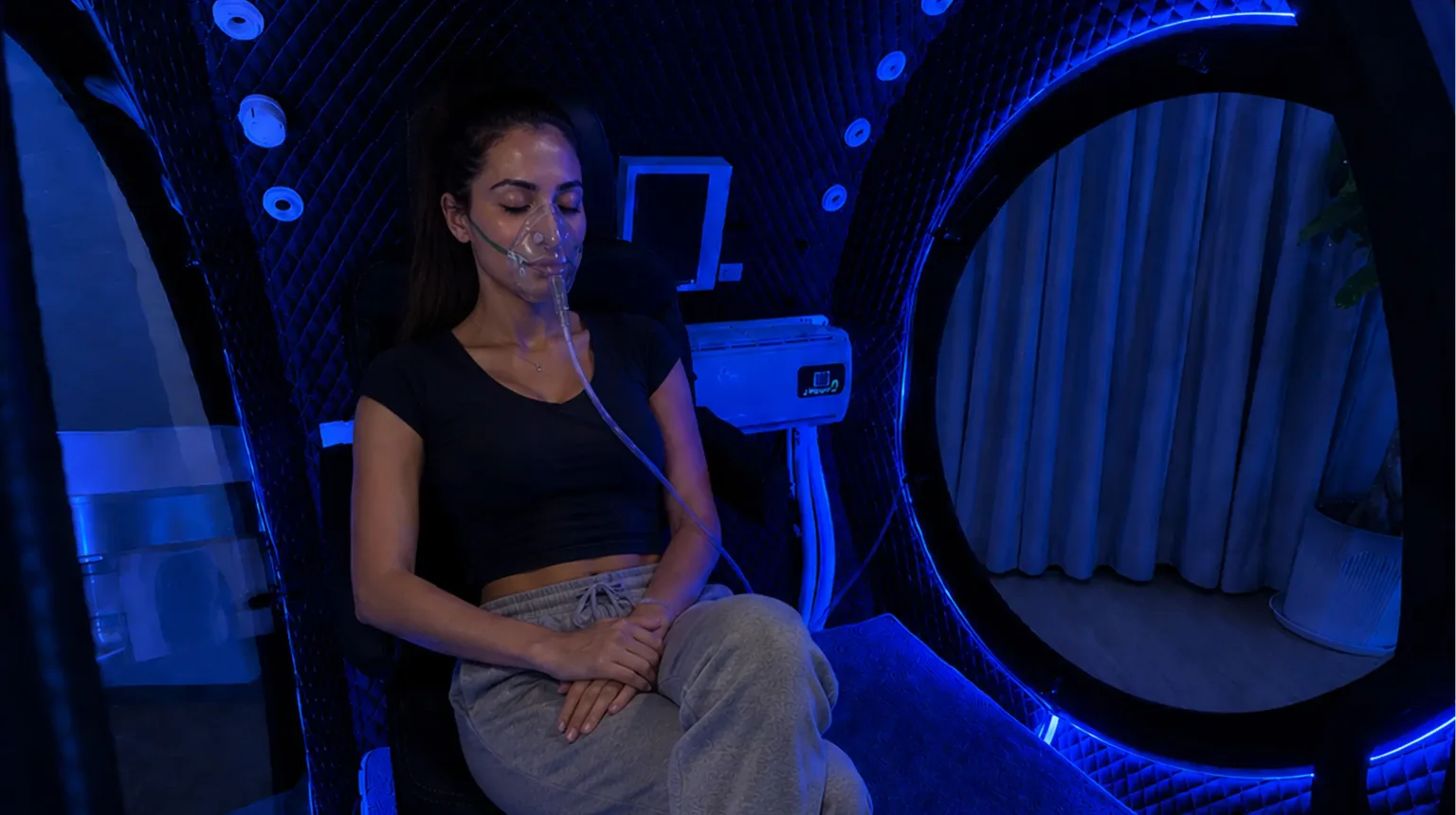
What happens minute by minute inside a session
A session is four phases, not one. Most “how long” confusion disappears once you see the anatomy: a compression ramp, time at pressure, air breaks inside that time, and a decompression ramp. Here is a representative 90-minute-at-pressure session, the profile used in the most cited longevity research protocol (Hachmo et al., 2020, PMID 33206062).
| Clock time | Phase | What happens |
|---|---|---|
| 0–10 min | Compression | Chamber pressurizes to target depth at about 1 meter per minute, roughly 10 minutes to 2.0 ATA |
| 10–90 min | Time at pressure | 80 minutes at depth on oxygen, with 5-minute air breaks every 20 minutes built in |
| 90–100 min | Decompression | Pressure returns to normal at the same controlled rate |
| After | Post-checks | Staff check ears, blood pressure, and pulse (and glucose in diabetic patients) |
Compression: 10–15 minutes
The chamber cannot jump straight to depth. Pressure rises at a controlled rate, about 1 meter per minute in published research protocols, and 10–15 minutes is the common clinical range for reaching working depth. The ramp is slow for one reason: your ears need time to equalize as pressure builds. Ear-clearing technique, what to wear, and every other first-session sensation are covered step by step in our guide to what your first HBOT session feels like.
Time at pressure
This is the therapeutic window, typically 60–90 minutes in wellness settings and up to 2 hours clinically. At depth, oxygen dissolves into blood plasma far beyond normal levels. The protocol parameters that define this phase (pressure, oxygen concentration, session length) interact, which is why our explainer on hyperbaric chamber pressure levels is the right companion read: a 60-minute session at 1.3 ATA and a 90-minute session at 2.0 ATA are not interchangeable doses.
Air breaks, and why they exist
In clinical and research protocols at 2.0 ATA on 100% oxygen, the time at pressure is punctuated by air breaks: short intervals, typically 5 minutes every 20 minutes in the Efrati-group longevity protocol, and two air breaks per treatment in standard UHMS clinical profiles. The mask comes off and you breathe normal chamber air. Air breaks exist to reduce the oxygen-toxicity risk of sustained high-pressure oxygen, and they are one reason session length is engineered rather than improvised. At mild wellness pressures on concentrated air, breaks are often unnecessary.
Decompression: 10–15 minutes
The chamber returns to surface pressure at the same controlled rate, about 1 meter per minute. Cleveland Clinic notes that staff then check your ears, blood pressure, and pulse before you leave, which is part of why door-to-door time always exceeds the advertised session length.
Why sessions stop at about two hours
The ceiling is oxygen exposure management, not an arbitrary rule. Mayo Clinic’s risk guidance states plainly that the risk of complications increases with longer and repeated therapies, with seizures from excess oxygen in the central nervous system the serious, if uncommon, concern. There is no hard regulatory two-hour limit, but oxygen-toxicity math explains why higher-pressure sessions cluster at 90 minutes to 2 hours.
The reference numbers come from diving physiology. NOAA single-exposure limits (reproduced in Pollock 2019) cap a single oxygen exposure at 45 minutes at a PO2 of 1.6 ATA, 150 minutes at 1.4 ATA, and 210 minutes at 1.2 ATA. Medical HBOT at 2.0 ATA on 100% oxygen sits near the aggressive end of that envelope, which is exactly why air breaks are inserted and why protocols stop where they do. Mild-pressure wellness sessions breathe far less oxygen and stay comfortably inside these limits, but the same logic still shapes the 60–90 minute norm.
There is also a practical ceiling. A two-hour visit per client is the longest block most clinics can schedule profitably and most clients will accept daily, five days a week, for four to eight weeks. Physiology sets the upper bound; scheduling confirms it.
How often should you use a hyperbaric chamber?
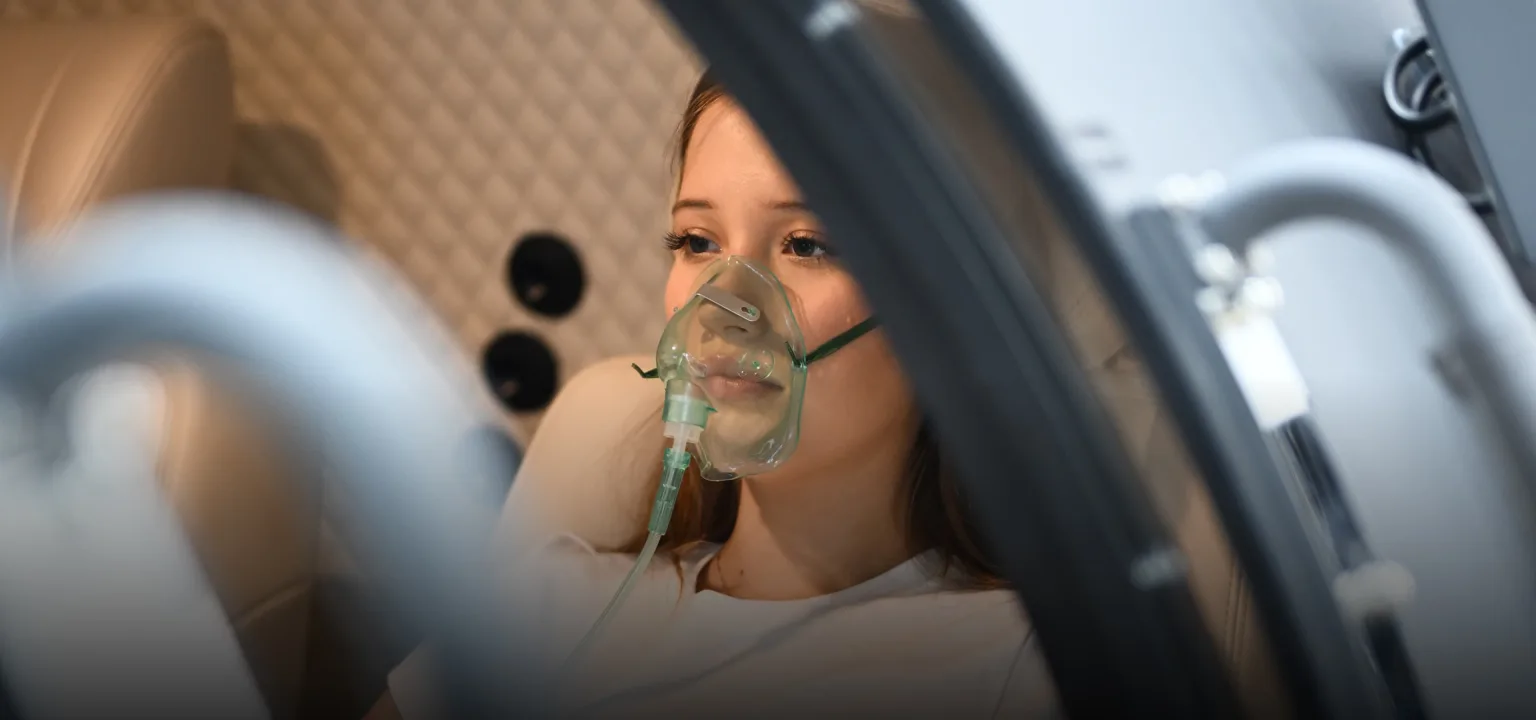
Frequency depends on the setting: five days a week clinically, three to five for wellness, daily inside structured research protocols.
The clinical norm: five days a week
UVA Health gives the cleanest clinical schedule on record: daily sessions, Monday through Friday, two-hour sessions, 20–50 sessions depending on diagnosis. The UHMS describes the standard treatment profile the same way: 90 minutes of oxygen time at 2.2–2.4 ATA, one treatment daily, five days a week. Total course length by condition is its own topic; our guide to how many HBOT sessions you need covers it in full. For the mechanism behind why repeated daily exposure matters, see our hyperbaric oxygen therapy explainer.
The longevity research protocol: 60 sessions, five days a week
The most cited wellness-side schedule comes from Hachmo, Hadanny, Efrati and colleagues (2020): 60 sessions, five sessions per week over three months, 100% oxygen by mask at 2.0 ATA for 90 minutes per session, with 5-minute air breaks every 20 minutes. The study reported increased telomere length and reduced immunosenescent cells in isolated blood cells, and a 2022 review of HBOT for healthy aging describes this as the canonical longevity protocol. Grade it honestly: it was a prospective trial of 35 enrolled (30 completed), with no control group, and its authors were affiliated with the clinic that sells the protocol. It is the best-documented wellness schedule in the literature, not proof that HBOT reverses aging.
Home and wellness use: three to five sessions per week
Outside structured protocols, the common wellness-market norm is three to five sessions per week, with daily use acceptable inside time-limited programs. Consistency matters more than intensity here: five sessions a week for a defined block beats sporadic marathon weeks. Treat these numbers as market practice rather than medical guidance, and let any medical protocol be set by the treating physician.
How pressure level changes session length
Higher pressure means shorter safe exposure and more ramp time. The NOAA exposure limits make the relationship concrete: at a PO2 of 1.2 ATA you have 210 minutes of headroom; at 1.6 ATA, only 45. In practice this means a soft-shell session at 1.3 ATA on concentrated air can run 60–90 minutes with no air breaks and fast ramps, while a 2.0 ATA session on 100% oxygen needs slower pressurization, built-in air breaks, and a firmer stop at 90 minutes.
This is also the honest commercial dividing line. Mild-pressure chambers simply cannot reach the pressure at which the clinical and longevity protocols were run. A hard-shell chamber rated for 2.0 ATA, like the Superhuman T2, covers the full published protocol range from 1.3 to 2.0 ATA, which is why session-length planning starts with knowing what pressure your chamber can actually deliver.
Hyperbaric chamber before and after: timing your sessions
Time of day and eating beforehand
There is no evidence-based “best hour” for HBOT. Clinical units simply run clients through a daytime schedule, and wellness operators report clients split between morning sessions before work and late-afternoon recovery slots. The practical guidance is boring and reliable: eat a light meal one to two hours before, hydrate normally, and skip anything that makes ear pressure harder to manage, like flying or diving immediately afterward. Pick the slot you can keep five times a week; the protocol you actually follow beats the theoretically optimal one you skip.
Exercise before or after?
Most wellness users place HBOT after training, positioning it as a recovery block, and that is the scheduling pattern athletic-recovery programs publish. Nothing in the clinical literature forbids training the same day. The scheduling constraint is fatigue, not physiology: a hard session plus a 90-minute dive can leave you flat for the rest of the day.
What you feel right after a session
Mayo Clinic notes you may feel tired or hungry after treatment, and Cleveland Clinic describes the routine post-session checks on ears, blood pressure, and pulse. Mild fatigue and a feeling of fullness or popping in the ears are normal for the first few sessions. Plan your first week’s sessions for days without back-to-back commitments until you know how your body responds.
Session length FAQ
These answers are general education. Any medically indicated HBOT schedule should be set by your physician.
How long do you stay in a hyperbaric chamber?
60–90 minutes at pressure for wellness sessions, up to 2 hours for clinical treatments, plus 10–15 minutes of ramp time on each end. Budget 90–120 minutes door to door.
How long can you stay in a hyperbaric chamber at 1.3 ATA?
At 1.3 ATA on concentrated air, oxygen-toxicity headroom is wide (NOAA’s limit at a comparable PO2 is 150–210 minutes), so sessions of 60–90 minutes are the comfortable market norm with no air breaks required. Longer stays are possible under supervision but uncommon.
Can you do HBOT every day?
Yes, daily sessions are the clinical standard: Monday through Friday, five days a week, per UVA Health and UHMS profiles. The longevity research protocol also ran five sessions per week for 12 weeks. Seven consecutive days is less common; most programs build in rest days.
How many HBOT sessions are normal?
Clinical courses run 20–50 sessions by diagnosis (UVA Health); Mayo Clinic notes some conditions need only a few sessions while nonhealing wounds may need 40 or more. The full breakdown by goal lives in our guide to how many HBOT sessions you need.
Can you stay in a hyperbaric chamber overnight?
Not as part of any standard session protocol. Sessions are capped near two hours for oxygen-toxicity and practical reasons. Extended and overnight stays are a separate topic with their own safety logic; see can you sleep in a hyperbaric chamber.
How long is one session in a hard-shell hyperbaric chamber?
Same physiology, same clock: 60–90 minutes at pressure depending on protocol, 90–120 minutes door to door. Hard-shell chambers simply enable the higher-pressure protocols (1.5–2.0 ATA) that need the full 10–15 minute ramps and air breaks.
Planning your own schedule
For clinic operators, session length is throughput math. A 90-minute dive with 30 minutes of turnaround is a two-hour block, so one chamber realistically hosts four to five clients per day on a standard schedule. A 60-minute mild-pressure format lifts that to six to seven. That difference drives pricing, staffing, and payback period, which is why session format belongs in the same conversation as hyperbaric chamber cost before any equipment decision.
For home users, it is a weekly time budget. At 90–120 minutes per visit, three to five times a week, a serious routine consumes 4.5 to 10 hours weekly for a typical 8-to-12-week block. Owning a chamber removes travel from that math, which is usually the deciding factor: the protocol that wins is the one your calendar can actually hold for three months straight.
Limitations and open questions
- No dose-response trials for wellness use. The 3–5x/week wellness norm is market practice extrapolated from clinical schedules and one research protocol, not the output of head-to-head frequency studies.
- The longevity protocol is one small uncontrolled trial. Hachmo et al. 2020 enrolled 35 adults with no control group, and its biomarker findings have not been replicated in large randomized trials. Its schedule is well documented; its outcomes are preliminary.
- Ramp and break times vary by chamber and operator. The 1 meter/minute rate comes from one research protocol; your facility’s profile may differ, and manufacturer instructions govern.
- Clinical numbers assume physician supervision. Everything in the clinical column of this article describes hospital-based HBOT for cleared indications, not self-directed use.
References
- Cleveland Clinic: Hyperbaric Oxygen Therapy
- Mayo Clinic: Hyperbaric Oxygen Therapy
- UVA Health: Hyperbaric Oxygen Therapy
- Hachmo Y, Hadanny A, Efrati S, et al. Hyperbaric oxygen therapy increases telomere length and decreases immunosenescence in isolated blood cells: a prospective trial. Aging (Albany NY). 2020. PMID 33206062.
- Fu Q, et al. Hyperbaric oxygen therapy for healthy aging: From mechanisms to therapeutics. Redox Biology. 2022.
- UHMS 2020 Annual Scientific Meeting abstracts
- Pollock NW. Oxygen hazards and safety considerations (NOAA oxygen exposure limits). 2019.